Bringing Solar Power to 26 Million Homes Off the Grid
with Patrick Walsh & Anish Thakkar
Co-Founders of Sun King
Hosted by
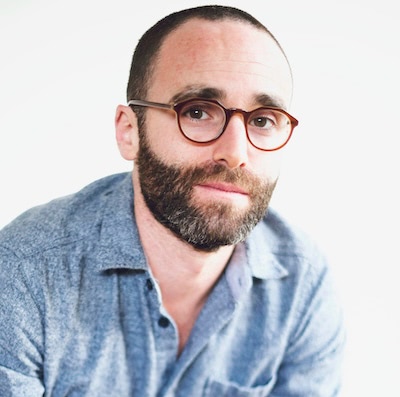
CEO, Unreasonable Group
About This Episode
Featured Guest
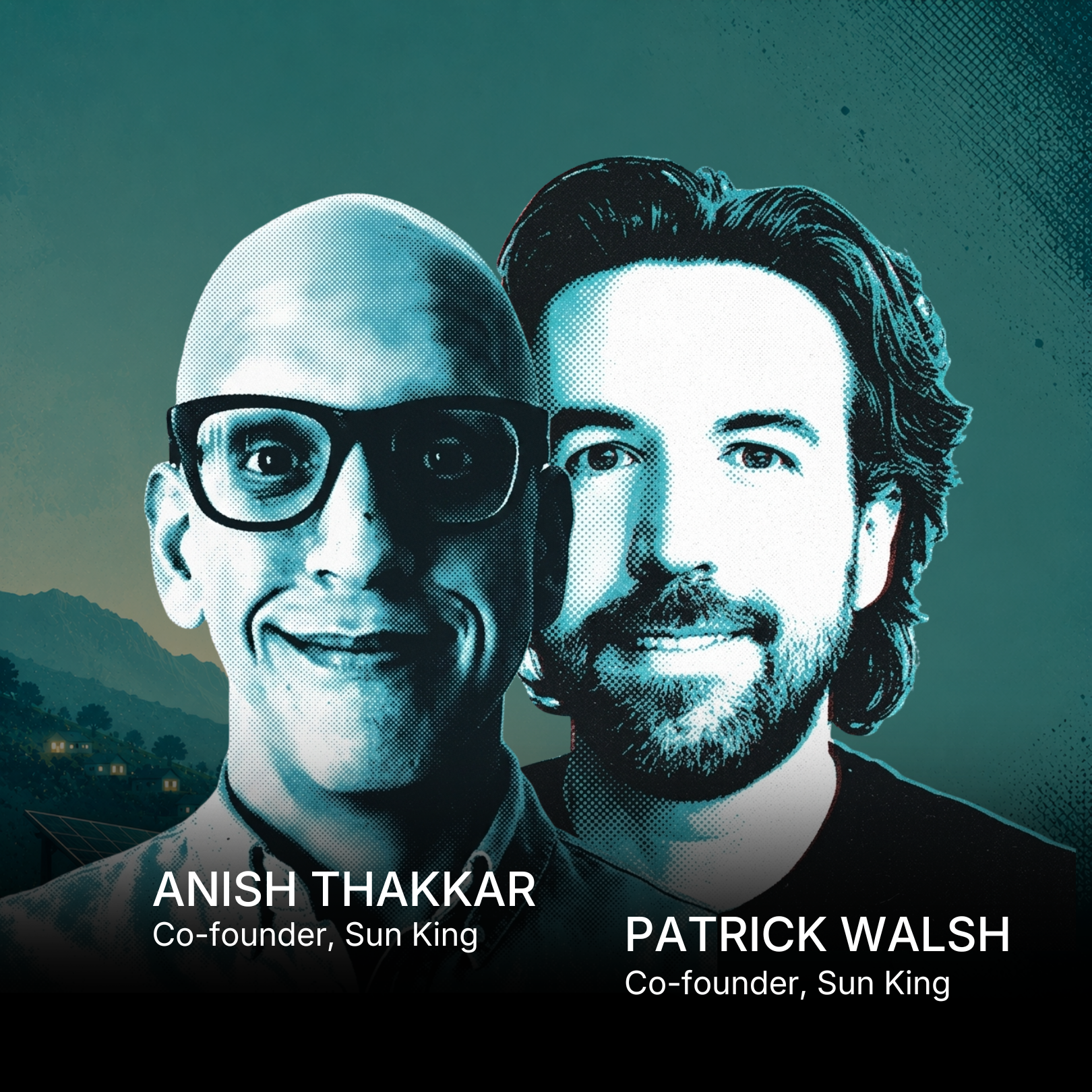
Patrick Walsh & Anish Thakkar
Co-Founders of Sun KingPatrick Walsh and Anish Thakkar are the co-founders of Sun King, the world's largest off-grid solar energy company. They met as undergraduates at the University of Illinois, where Patrick designed the first Sun King solar lantern in 2006 through work with Engineers Without Borders. Over two decades, Sun King has brought solar power to more than 26 million homes across 46 countries. Anish joined the Unreasonable Fellowship in 2014 and Patrick in 2017 through the Unreasonable Impact program, run in partnership with Barclays.
Key Takeaways
Sun King has brought solar power to more than 26 million homes across 46 countries, created work for over 37,000 field agents, and extended more than $1.7 billion in financing to customers who could not otherwise have afforded it.
Sun King grew out of Engineers Without Borders at the University of Illinois, where Patrick Walsh and Anish Thakkar met as undergraduates. Patrick designed the first Sun King solar lantern in 2006 to replace the kerosene lamps families relied on for light.
To reach customers living on a few dollars a day, Sun King built pay-as-you-go solar. A family pays about $5 up front, then roughly $2 a week until the system unlocks, working much like a prepaid SIM card that stays on only while it is topped up.
Sun King's first sale was in a village in Uttar Pradesh, where an older man paid a thousand rupees for a solar light and said if it broke he would find them. That leap of trust became the model for its village agent network.
Patrick Walsh joined the Unreasonable Fellowship in 2017 through the Unreasonable Impact Program in Asia-Pacific, run in partnership with Barclays. Anish Thakkar had come in earlier, in 2014, and Unreasonable has backed both founders for close to a decade.
After twenty years as co-founders, Patrick and Anish credit trust above complementary skills or aligned opinions. It is what lets them disagree often and still defer to one another, each certain the other has the team's and customers' interests at heart.
Asked how listeners could help, Anish Thakkar told investors not to fund Sun King but to back founders from Nigeria, Zambia, Malawi, Kenya and Tanzania, arguing too little Western capital reaches entrepreneurs building from inside the communities they serve.
Chapters
Full Transcript
Daniel Epstein (0:00)
Today, I get the chance to have a conversation with two individuals I really love and admire. That is Anish and Patrick, the co-founders of a once small, now large company called Sun King. We brought Anish into the fellowship back in 2014 when we were running a program called Girl Effect Accelerator with Nike, and Patrick joined us a little bit later in 2017 with our Unreasonable Impact Asia-Pacific program that we run with our partners at Barclays. So we've been on this journey with Patrick and Anish now for a little bit over a decade. They started Sun King about 20 years ago, so two decades ago. And they had a simple mission, which is to bring electrification to the nearly billion people who live off the grid and don't currently have access to electricity, largely in Sub-Saharan Africa, but across Asia Pacific as well. Today, they have brought solar energy to over 26 million homes, that is million. They are providing jobs for more than 37,000 field agents who are going out and selling these solar products in villages really around the Global South. They are selling products across 46 countries. They have shops and hubs and headquarters based in more than 10 countries. They've extended more than $1.5 billion in loans to finance the purchasing power of these customers. They have over 4,000 full-time employees, and as you will see in this conversation, they're just getting started. I'm going to mention those numbers a couple of times because they are staggering and the potential of what Sun King has built now over the last 20 years, is remarkable as we look forward to the next 20, to the next 50, to the next 100 because these two co-founders, Anish and Patrick, certainly have a long-tail vision. So without further ado, I hope you enjoy this conversation as much as I will. Anish and Patrick, it is a pleasure to share this time and this space in this conversation with you both. Thank you for making the time to be here.
Patrick Walsh (2:07)
Thanks for having us.
Anish Thakkar (2:09)
Thanks.
Daniel Epstein (2:09)
Of course, of course. You know, we actually—our journey goes back a decent ways. I know Anish, you first came to us through the Girl Effect Accelerator with Nike Foundation, I think in 2014. And then Patrick, you joined us at Unreasonable Impact Asia-Pacific gathering with Barclays in 2017. So you know, nearly a decade we've known each other, Patrick and Anish, we go further back. I will say it's been a privilege to witness you both, both as co-founders of Sun King but also just to witness the amount of impact that you all are having in the market. For someone who's listening in on this conversation, I did look up, right before the most recent numbers, and they're huge. I believe, and you all can correct me if I'm wrong, but today you're bringing solar to more than 26 million homes. You're supporting more than 37,000 jobs of your agents on the ground. You've sold solar. You also have operations in over 46 countries. We were just chatting; you've raised, in debt and equity, about $800 million. You've provided over $1.5 billion of loans to people who otherwise likely could not afford solar. The impact is massive, and I wanted to start not with where we are or even where we're going, but where we came from. I'd love to hear just where did Sun King start? How did you two come together as co-founders and kind of what gave you permission to think, you know, 20 years ago nearly, that this was even a possibility?
Patrick Walsh (3:53)
Well, we met as undergraduate students, and Sun King really grew out of some nonprofit work happening at the University of Illinois at Urbana-Champaign, doing rural electrification work through the student organization, Engineers Without Borders.
Daniel Epstein (4:11)
That's right.
Patrick Walsh (4:11)
So in the course of that work, we realized that we were not going to solve for global energy needs through that mechanism, through charitable contributions and micro-grids alone, that we needed to find scalable commercial solutions that individual households could invest in and solve their own energy needs. So it began with replacing kerosene lamps with simple solar lanterns. And today we're making solar kits, large solar systems that power everything in the home, in businesses, and more. So that was the genesis.
Daniel Epstein (4:47)
If somebody is listening to this and doesn't have the context of kerosene lanterns or of, individuals in emerging markets who currently don't have access to electrification, can you describe why it matters to switch over to solar?
Patrick Walsh (5:02)
Yes. So for people who don't have electricity, if you're limited to kerosene lamps or candles, kids can't study. People are spending large fractions of their income on just a meager amount of light for the home. People have to rush home from work, whether it's in the field or at a business, just to get a few things done before sundown. So it limits people's productivity, their education, their health. Burning kerosene fumes inside the home, it's dangerous. Fires started by these devices, that's just on the lighting side. But then nowadays, people need access to at least a small amount of electricity just to be connected, to have a connection to the Internet. So if you don't have that first few watts of electricity, the very beginning of electricity, it's just enormously difficult for the family. And that's what we set out to try to solve.
Daniel Epstein (5:54)
Yeah. I remember reading at one point that if you were lighting your home with the kerosene lantern, that was the equivalent of every man, woman and child within that home smoking two packs of cigarettes a day, just because of the fumes that came off of the kerosene, let alone the dimness of the light. Is that true? Is it that hazardous to someone's health?
Patrick Walsh (6:15)
I don't know.
Daniel Epstein (6:17)
Okay, we'll look it up.
Patrick Walsh (6:19)
We can look that one up. But, you know, one of the things that we've realized over the years is that there are massive needs in people's homes, in people's small businesses. This is not just about lighting and basic energy needs.
Daniel Epstein (6:34)
That's right.
Patrick Walsh (6:35)
And nowadays, the scope of what we've been trying to achieve has really grown because of the fact that what we can do from a technological perspective has grown with solar technology and battery technology moving so far along. I mean, when we started, solar panels cost $4 per watt, and now they cost less than $0.10 per watt. So it's 40x reduction in the cost of solar. It's not quite that large of a factor, but a similar sort of thing has happened in the battery industry. And so, you know, 20 years ago, if you wanted a very tiny amount of electricity, the most efficient way to provide it was with solar. But today, no matter how much electricity you want, the cheapest way to provide it is solar in many contexts. Unless you're in a very dense urban environment where there's not enough room on the roof for solar panels. If you're in a rural location and there's no electricity, you buy the number of batteries and solar panels that you need. That's the most efficient way to get connected. So today we're solving for all kinds of needs, you know, and when you asked about indoor air pollution, I think it's actually hard to tease out what the effect of kerosene lamps is because people are also breathing in smoke from their cook stoves, from their charcoal stove or their wood stove. And so we've really reset our targets to not just focus on these basic electricity needs, but also to focus on the broader energy needs in the home. So we've expanded and we're trying to do clean cooking and other areas.
Daniel Epstein (8:08)
Yes, cooking, connectivity, lighting, and I imagine, others. Let's go back before we go into the future, back to 20 years. You're both at Champaign, you're at University in undergrad in Illinois. And you—it sounds like you're volunteering with doctors or not doctors, Engineers Without Borders, but a niche to pull you in. Was there—this is almost a cheesy question—but was there an "aha" moment for you or how did this come into being and at what point—maybe you could tell the story and you both might have different versions of the story—did you both decide, "hey, we're actually going to start a company"? And how did you start a company if you were co-founders out of Illinois that was starting in, was it originally India? And now I know you're in 46 countries. But how did all this come to be?
Anish Thakkar (8:55)
Patrick had been working with Engineers Without Borders as an undergraduate student for a few years before he and I met, and I heard about the amazing project that he was working on. And I was studying electrical engineering. And as I was approaching my senior year, really confused about what I wanted to do with my life.
Daniel Epstein (9:15)
That's right.
Anish Thakkar (9:15)
Technology's amazing. It can do so much for the world. And I was involved in some biomedical research efforts. And so I thought, okay, maybe that's where I want to apply what I've learned and work in the research area. But just something about that just felt too long term. And when I met Patrick, this was 2006. This was the dawn of the iPhone. And every engineering student, it seemed, was starting a company that was an app on a phone. Uber had just come out and what an amazing time to use this emerging technology to reorganize how the world works. But I think meeting Patrick was really clarifying and seeing what he was working on because it sort of showed that there's all these great opportunities to use technology, but to order a taxi faster or an alternative to a hotel room, it's always so exciting. There are these basic problems, like a billion.
Daniel Epstein (10:06)
It's convenient.
Anish Thakkar (10:07)
Yeah, but there's a billion people that don't have reliable power in their house. And what the hell are we using technology for if not to solve the needs of, yeah, like the billion least enfranchised, most underserved consumers and global citizens. So that was just such a clarifying moment for me. I think when I met Patrick and saw the project he was working on when he was designing the first Sun King solar lantern, I think I just knew this is what I wanted to do out of college. And that's what we've been doing for the last 20 years.
Daniel Epstein (10:38)
So you're 20 years into this. But then that makes sense. It pulled at your heart. You had clarity around, you know, the nature of the type of work or impact you wanted to have in the world. You meet Patrick, you're like, oh, wow, this is the thing I was looking for. Maybe I didn't even know existed. But then, how did you start a company based out of India when you both—I'm still assuming, but I could be wrong—were in Illinois?
Anish Thakkar (11:01)
Well, at the time, Patrick had the first prototype solar lantern in a lab and was just getting ready to figure out how to make the thing in great scale. Early on, what we looked at was the basic Nokia brick phone. It was like a $20 smartphone or $20 feature phone that was affordable to hundreds of millions of people that had never had a phone connection to their home.
Daniel Epstein (11:22)
That's right.
Anish Thakkar (11:23)
And what made it possible was really efficient, really high-scale manufacturing that could drive down the cost of a phone. So if we could apply the same principles to solar lighting, the solar panel, the battery, the LED lights, put that into a package that could be manufactured at really high scale, at really efficient—in an efficient way. So it was low cost, then maybe hundreds of millions of people that don't have a connection to the electric grid could have a light source in their home for the first time. So that was really the beginning. And when Patrick and I graduated and started Sun King, Patrick moved to China to set up product side of the business and I moved to India because that was our first market. And so the idea was Patrick is going to figure out how to make this thing. I'm going to figure out how to sell it.
Daniel Epstein (12:00)
And how—
Patrick Walsh (12:01)
Before he even moved to India, he raised our seed round of funding in about—
Daniel Epstein (12:08)
That was my question.
Patrick Walsh (12:09)
It's just about 50 times faster than I ever thought that could be possible.
Daniel Epstein (12:15)
Well done, well done, well done. And like, and how did that happen? Like to convince, you know, the first dollars to support you all to move to China and then India to try to get this all ultra efficient, kind of simple solar light product into market. You had these ambitions of you saying a billion people don't have electrification. You're throwing these huge numbers. How did you get the first capital in to support you all?
Anish Thakkar (12:41)
This was one of the big challenges 20 years ago and I think it still is today.
Daniel Epstein (12:44)
I'm sure.
Anish Thakkar (12:45)
Where's the capital? The capital's in the west, the capital's pointed at the shiniest, hypiest—
Daniel Epstein (12:51)
Right now. Then it was apps, now it's AI.
Anish Thakkar (12:53)
Exactly. I remember Patrick and I would come out of these rooms where we're pitching to angel investors and the questions would basically—they were so misinformed. "Do these people even have money? Can they even afford food? Can they even afford clothes?" "How can they afford a solar light?" So, that was a really big challenge 20 years ago. And I think we just had the real great luck of meeting a man named Prabha Sinha. So actually when we graduated from university, I started working for a consulting company called ZS Associates.
Daniel Epstein (13:19)
Mhm.
Anish Thakkar (13:19)
And so that was during the day, nights and weekends working on Sun King. And about a year in, the first Sun King solar lantern was ready to start producing in a production line and it was time to quit and move on. So I put my notice in. This is like about a year after graduating working at ZS. And it turned out that ZS was having its 25th anniversary party, and I was working in the head office in Chicago. So I got an invite to the party right before I left, hung onto the invite. I showed up at the party actually after I'd already left the company, and I knew that it was one of the founders of ZS, Prabha Sinha. He was the S in ZS.
Daniel Epstein (13:52)
Yep.
Anish Thakkar (13:53)
And Prabha grew up in India in what is actually the most under electrified part of India, Bihar. And I figured, you know, here's someone who must understand the issue we're trying to solve at a really fundamental level, and maybe he can help us raise the seed funding. So basically I showed up and sort of cornered him at this large corporate party and said, "hey, my name's Anish, I don't work for your company anymore, but I used to." And before he could ask, you know, "what the hell are you doing here?" I pulled the prototype solar lantern out of my pocket and told him what we were doing. And he was interested enough, so he said, "well, why don't you come meet me next week?" And so Patrick and I went and told him the idea of Sun King. And he wrote the first check as an investor in Sun King and brought a couple other principals from the company in too. And Prabha has been on our board for the last 20 years. And he's been such a great mentor and advisor and friend. And I don't think we would have been on this journey if we hadn't managed to cross paths when we did.
Daniel Epstein (14:49)
He sounds incredible, but I also feel like you two are—you had such clarity of vision and you're so hell-bent and determined that somehow, you would have found a way. But what a gift it was, you know, to meet him then in that moment. Somebody's tuning into this. Okay, you're trying to reach the billion people who don't have access to electricity or living off the grid. Many of them are living on less than two and a half dollars a day. How do you sell them a modern solar light, no matter how cheap you can get it, with efficiencies? And I know this is where financing comes into play as well, but can you explain how that works?
Anish Thakkar (15:23)
Well, I remember when we had the first Sun King solar lights off of the production line. Patrick sent me a box of five. And the first thing that we did was basically drove out of New Delhi and drove into the state of Uttar Pradesh, which is 200 million people, has one of the lowest electrification rates in the country. We basically just drove to a village that was off the grid. And we were there with someone who their family came from that village. And so they sort of brought us in, and we basically just came out of a car and popped open this box of the first Sun King solar lights and started showing them. And we wanted to see what people would think. And one of the great things about showing up in rural India as an American is that you can form a crowd very fast.
Daniel Epstein (16:04)
That's true.
Anish Thakkar (16:05)
Within a blink of an eye, there's maybe like one hundred and fifty people around us and trying to demonstrate this thing. And I'm explaining things in English and the person who brought us there is explaining things in Hindi. We're basically just there to get feedback. And at one point, the kind of product pitch ends and I'm looking at this huge crowd and this older gentleman moves out of the crowd and kind of walks up and picks it up and then he says something in Hindi that I didn't understand and he just walks away carrying the solar light and just walks out of the crowd. Opens the door to his house and goes inside and closes the door.
Daniel Epstein (16:41)
I love this man.
Anish Thakkar (16:44)
I was very worried at that point about what we'd gotten ourselves into and what he was doing with one of our only solar lights. And then after a couple moments he came out with a thousand rupee note in his hand and—
Daniel Epstein (16:55)
Wow.
Anish Thakkar (16:56)
And he bought it.
Daniel Epstein (16:56)
Wow.
Anish Thakkar (16:57)
After a couple of moments, he kind of goes over to the gentleman that brought us to the village and he says, "I'm buying this thing, but if it breaks, I know your family, and I'll track you down."
Daniel Epstein (17:10)
Yeah.
Anish Thakkar (17:10)
So it better work.
Daniel Epstein (17:11)
That's very important.
Anish Thakkar (17:12)
And then he just went back to his house. So it was really kind of an eye opening moment that we spent a long time in the first years in the company trying to get the products right. But we also had to get the commercialization approach right, the route to market. And the first experience taught us is we have to rely on the trust of people that live in the communities we're trying to serve. And that's what it takes to get someone who doesn't understand what you're selling and doesn't know you to take that leap of faith. And so that was sort of the second big journey for us after figuring out how to make the right product was figuring out how to bring it to all the families and homes that we wanted to serve. And so we started to build this really big network of village-based sales agents. You know, they're Sun King users first, so they live in their own home with Sun King. And then they would go door to door and explain the virtues of the product to everyone in their community and you know, if they would sell a solar lantern, you know, they could say like, "look, I don't know you, but I live one village over and if you have a problem, just knock on my door and I'm here to fix it." And that really was just a critical piece in making this very new technology you know, accessible and trusted by all the people we wanted to bring it to.
Daniel Epstein (18:21)
That makes so much sense. And these solar agents today that you have on the ground, you know, that are selling village to village, how many are now a part of the network? What's the most up-to-date number?
Anish Thakkar (18:32)
So now in 11 countries we have 450 branches and we have 37,000 field agents who go door to door and sell Sun King.
Daniel Epstein (18:40)
This isn't just electrification, it's also like incredible, in terms of job creation. That's a huge number. Does this tend to be their livelihood or is it supplemental or does it depend?
Anish Thakkar (18:49)
So most are full time. About half are women.
Daniel Epstein (18:52)
Incredible.
Anish Thakkar (18:53)
And they're all Sun King users first. So they're powering their house with Sun King first and they're making it available for people in their community and the sort of communities nearby. Mhm.
Daniel Epstein (19:01)
And then Patrick, I want to hear about building a supply chain in China. We're going to get there. But can you explain maybe even now, today, just the financing aspect? So the first customer had a thousand rupee note that he could hand you. I imagine many people don't have that cash up front. I know financing has been a huge part of the challenge that needed to be cracked to be able to hit the scale you have. Can you talk about how that's evolved over time and how you help finance the purchasing power of those who don't have the money up front?
Anish Thakkar (19:35)
We think about the company almost in three chapters. So one was figuring out the products. Second was figuring out how to actually bring it to people in a way that—
Daniel Epstein (19:42)
They would trust.
Anish Thakkar (19:44)
The third challenge then is the purchase financing. What we saw was that we had many agents who were pretty successful at selling solar lanterns.
Daniel Epstein (19:51)
Mhm.
Anish Thakkar (19:53)
But the big challenge they faced was that there was 50 homes that wanted that thing today and knew it would be a good investment, but only five homes could afford it. The great thing about solar home systems and solar lanterns is that they provide a lot more power than say a kerosene lantern. And they typically pay for themselves in anything from six months to 18 months because once you have a solar energy source, you save on kerosene for lighting.
Daniel Epstein (20:22)
You don't need the fuel.
Anish Thakkar (20:23)
Yeah, and you also save on phone charging fees. So a lot of homes that have a smartphone, you have to go into a town, you have to pay some money, you have to charge your phone. But the big challenge is the upfront cost. Just like, you know, decarbonization effort everywhere in the world.
Daniel Epstein (20:37)
Yep.
Anish Thakkar (20:37)
You know, every society, everyone's trying to figure out how do you pay for the solar and batteries or the next renewable energy CapEx investment that pays for itself over time. It's the same issue for an off-grid home—the challenges. One of the amazing things is the break even period is so short but you know, the overlap between off-grid grid and unbanked is so high. So it's not like our customers can just go to their bank and say "okay, I need a loan to buy this solar asset." And so we had to way to provide that financing ourselves. So what we do is pay-as-you-go solar. So rather than paying say $100 for a solar kit that would light up every room in your house and charge your phones, and maybe power a radio, our agents ask customers to pay $5 up front. Our customers are—in every case, they go through a credit approval process. They get approved for credit, usually in about 10 minutes. And then the customer pays that $5 upfront payment. The agent installs the solar system in the house right there and activates it with the payment plan. So that payment plan might be say $2 a week paid off over 12 months, over 52 weekly payments. And so the customer makes that first one week payment. The system is topped up with one week balance of energy. So there's a little screen on the product that shows seven days of balance. For the next seven days, the customer can get power output day and night. And at the end of seven days, there's a zero on the balance on the screen. And so now it's time for a next payment. So the customer makes a top-up payment. And so they go through that every week. Week after week, they make top-up payments until they've made 52 weekly payments. Now they've paid it off and the system is unlocked. So it works pretty much like a prepaid SIM card. You have to maintain a positive balance to keep getting light every day. That allows us to extend financing to a lot of households all at once. So, to date we've extended over $1.7 billion in purchase financing.
Daniel Epstein (22:33)
Wow.
Anish Thakkar (22:34)
And it's really just about, you know, in many cases say like anything from like a $40 to $100 solar loan that unlocks the affordability for households. And then as customers pay off their solar home system then you know, the first thing we solve is say lighting and phone charging. But now we've gone through this journey with you, you've paid off the system over the course of the year, you trust the product. And for so many of our customers, it's not just about lighting. The aspirations of the grid connected modern world is really what people want. And so many customers go on to finance, and upgrade. So they add more solar panels, more battery storage and appliances like a tv, a fan, soon a refrigerator. That's really about enabling customers to go on this long-term journey where they can afford to make the switch to solar and then add more solar and battery storage. All the appliances that make modern life so great.
Daniel Epstein (23:29)
Yeah, amazing. I imagine in that example they pay $5 up front, then $2 a week and is it fair to say that $2 a week until it's paid off, is that equivalent to what they were paying on kerosene fuel as an alternative, is it less? Like how does that compare for them in terms of their just weekly spend until they own it, of course?
Anish Thakkar (23:51)
It really depends on the household. Ideally, we want this to be household spend on kerosene and phone charging before they get solar. And that's really the key for us is trying to find ways to make this more and more efficient so we can deliver more power at lower and lower weekly payments. Because ideally you just redirect your expenses that you had on this inefficient source of energy, kerosene, lanterns, candles, batteries, paying to get your phone charged in the market town once a week, and just direct it towards paying off your solar asset. And that works for most of our customers.
Daniel Epstein (24:23)
So cool. Okay, two more questions, then we're going to go to China, which is you said how you can approve someone's credit in about 10 minutes. I'm curious how that works. The second one was just how do people top up payment? Is it all mobile money? Is cash actually being transferred at any time? Just curious how that works. And did work at the start too.
Anish Thakkar (24:43)
So I think this is unlike a lot of credit businesses in that our customers don't have credit scores.
Daniel Epstein (24:49)
Yes.
Anish Thakkar (24:49)
There's no salary slip, there's no bank statement, there's no FICO score. What we're focused on is do we know who the customer is? Do they understand what they're buying? Do they understand the terms and conditions? Payment obligation?
Daniel Epstein (25:03)
Yeah.
Anish Thakkar (25:04)
And so that's really what we're checking for. So the way it works is the agent pulls out an app on the phone, entering the potential customer's details, including their ID, geotag of the house, call center in each country office. One of our credit officers calls that potential customer, verifies who they are and then asks them some basic questions about what they're buying, what does it do, what does it not do? What are their obligations in the payment plan? How long are they—will they be paying for until the product is paid off? Making sure that the customer really understands what they're getting themselves into before they say yes and start and make that first payment. That's really what we're looking for.
Daniel Epstein (25:38)
Love it.
Anish Thakkar (25:39)
And then over time, you know, build a credit history with that customer and then that allows us to extend.
Daniel Epstein (25:43)
Yeah, they pay off that first more affordable year.
Anish Thakkar (25:45)
And then we can add more. You know, we could provide financing for the next thing that customers want. So more solar, more battery storage, new appliances, a smartphone, a clean cooking solution.
Daniel Epstein (25:54)
Yep. Wow. In that sense, I didn't know this. You're providing financing now because you've in essence, through working with them, or having them as a customer, and having them pay off repeatedly every week to own their first unit, you can then assess their credibility. You can create almost their first credit score, if we want to call it that. And then are you providing—you're providing financing for even things like a smartphone. So it goes beyond just the solar electrification, is that right?
Anish Thakkar (26:22)
Yeah. And this has been one of the interesting things about how the vision of Sun King has really expanded. We see all the other, ways in which our customers are underserved.
Daniel Epstein (26:32)
Yes.
Anish Thakkar (26:32)
And there just really aren't a lot of alternatives for many customers. So the question we have is what other problems can we solve once we've been able to provide solar power to a home? And many of our customers say is that once lighting and phone charging is taken care of, what they want is a smartphone. "I had a feature phone because I didn't have a way to charge it in the house, and I have to go to the town once a week and charge this thing. Now I have a reliable power source. I'd love to get a smartphone. I can keep this thing charged every day." But a smartphone is an expensive asset. Entry level smartphone might cost 80 or $90, which is quite expensive up front. So now we can provide a smartphone to the customer and we can provide that same pay-as-you-go financing built into the smartphone. So we look for every way to make these things more affordable. Financing is part of it. We also—now we've set up our own production lines for smartphones in Kenya as a way to drive down the cost.
Daniel Epstein (27:23)
No way.
Anish Thakkar (27:24)
It's all about understanding what problems our customers have next and trying to leverage our product capability, the distribution, the financing to just create the most accessible solution for that problem. And so smartphones is sort of one extension. Refrigeration is another. Clean cooking is another. So we look at this as, you know, that first solar panel and battery in the house is sort of like the springboard to then solve many other problems and bring up many other solutions to our customers.
Daniel Epstein (27:53)
Yep. So cool. Okay, so you're in India. You get these first five lights. Patrick ships them over to you. You're going, in essence, into the villages door to door. You're trying to figure out how do we actually get this into market, how do we build trust, so on and so forth. Patrick, you're in China. What are you doing, and how is it going? Did you speak Mandarin at that point? How does one go from Illinois to China to set up a production line?
Patrick Walsh (28:18)
I was lucky enough to be very naive going into it.
Daniel Epstein (28:21)
Yeah, no kidding.
Patrick Walsh (28:24)
I went over to Shenzhen, well actually first to Hong Kong and then within a few weeks to Shenzhen, not having a clue, you know, what it took to mass produce a solar light with semiconductors and batteries and solar panels and assembly and quality control and all that kind of stuff and thank goodness I didn't know.
Daniel Epstein (28:42)
Patrick, how old are you, and what did you study?
Patrick Walsh (28:45)
I studied physics, and then I also studied economics in college.
Daniel Epstein (28:50)
Okay. Kind of, not electrical engineering.
Patrick Walsh (28:54)
At least adjacent, you know, I think it was a good liberal education in this kind of stuff. And there was a student from Hong Kong at the University of Illinois who I had gotten to know and when I finally graduated and you know, had time to go actually try to make these things, I called him up, and I rented his friend's apartment. I sub-letted an apartment there in Hong Kong and realized very quickly that it was even harder to get things done in Hong Kong than it was back at home because A, I wasn't at home and B, I wasn't where the, you know, the factories and the vendors and the raw materials are, which is actually across the border in mainland China in Shenzhen and Guangdong province. So I pretty quickly moved over there and started working on putting the product together. And I would totally encourage anybody else that's interested in doing this to try it because it's a fascinating process and did eventually get it done. But I remember taking a trip back to the States, you know, about six months in, and I had thought maybe this will take a year to, you know, to build up this capacity to manufacture these solar products. And I remember thinking after six months, you know, I think maybe originally I thought it would take six months and then I came back after six months, I thought, geez, it might take a year. And it really took about five years, you know, to get things even just started. So it was a long process and a lot of learning, and I'm glad that we started there because having great hardware has been a really important bedrock for what we're trying to do. But you know, we also realized very quickly, as you can tell from the distribution and the financing questions, that there's a lot more to it than having a great product. So I think one of the cool things about what we've been forced to do, but also been lucky to—I think if we had been, you know, trying to develop a product for the United States or for Europe. Typically, companies are only focused on one of these challenges. They're doing hardware, maybe they're just doing design. They don't even do assembly, or they're doing product, but they're not doing distribution. Or they're doing distribution, but they're not doing financing. But there are so few existing rails for us to build on in the markets that we're trying to support that we ended up doing all three of these things. And the way that the experience actually delivering the product to the customer, actually financing the product, meaning we don't get paid unless the customer actually uses the product, unless they actually like the product.
Daniel Epstein (31:18)
And it works. Yeah.
Patrick Walsh (31:20)
Yeah. And so building all those three things in one, you know, it meant that each area of the product, the distribution and the financing could kind of inform the other. An integrated embedded system that is efficient enough to deliver this technology at a price people can actually pay.
Daniel Epstein (31:34)
Yeah. It's incredible. Necessity seems like it forced you to be fully integrated as a company. The credit, the banking, the sales, the design, the manufacturing, everything. And in that sense, though, you could probably jump leaps ahead of anyone who's looking at one of those components because you're truly, holistically looking at one, the challenge and the solution. You mentioned you're onshoring, sounds like in Kenya, the assembly line. Can you talk a little bit more about that? And is that just for smartphones? Have you also done that with solar in the different countries that you have a big presence? I'm curious how the supply chain has evolved.
Patrick Walsh (32:12)
We haven't done it with solar, but we've done it with other appliances as well.
Daniel Epstein (32:16)
Yep.
Patrick Walsh (32:16)
We're evaluating doing that, for example, with refrigeration in Western Africa. Refrigerators are really bulky. They're really big. They cost a lot of money just to ship.
Daniel Epstein (32:25)
Of course, shipping them around is a different thing.
Patrick Walsh (32:28)
So, you know, there are various reasons why something could be more efficient to do locally versus, you know, globally. And, you know, we want to deliver the best product we can, a quality product at the lowest possible price. And so we're just always evaluating those nuances and where we can shave off whether it's logistical cost, you know, production costs, labor, taxes, you know, you name it. There's all kinds of things that go into that, but trying, to figure out how to deliver the product as affordably and as highest quality as we can across the different product lines.
Daniel Epstein (33:01)
You're talking about the quality of the product. These are out in, you know, oftentimes pretty remote villages. If the product breaks or malfunctions, one, how often does that happen? And two, what do the reverse logistics look like? Because I imagine that was its own puzzle to figure out.
Patrick Walsh (33:18)
Yeah. One of the critical functions of our agent network is exactly that. Anish was talking about how, that first customer, after they paid the thousand rupees, the first thing they said was, "if this doesn't work, I'm going to come find you."
Daniel Epstein (33:31)
I know where you live.
Patrick Walsh (33:32)
It wasn't a threat. It was a practical, you know, "I'm going to need your help." Right? "Like, the reason I'm able to invest, you know, a year's worth of kerosene cost in this product is because I know you and if I have a problem, I can come and find you and, you know, ask for help." And so we basically have to support those agents in providing support. Customers can walk into our shops as well. You know, we have 450 brick and mortar shops and they do. But, you know, often—
Daniel Epstein (34:03)
These are Sun King shops.
Patrick Walsh (34:05)
These are Sun King single-branded shops.
Daniel Epstein (34:07)
Right. Amazing. Incredible.
Patrick Walsh (34:08)
But 450 shops over 11 countries with a population—
Daniel Epstein (34:13)
Not that many.
Patrick Walsh (34:14)
you know, approaching 700, 800 million people. That's not that many. So, really the agents are a necessary logistical and just communication interface with the customer. And a lot of times, problems are not something that requires reverse logistics. It's, you know, we design these things to be as simple as possible. So they're very plug and play.
Daniel Epstein (34:37)
That's right.
Patrick Walsh (34:37)
We don't need even a screwdriver to install most of these products.
Daniel Epstein (34:40)
Yep. Incredible.
Patrick Walsh (34:41)
But they do need to be plugged in. And sometimes something just comes unplugged and a customer says it's not working. An agent can go to their house and just plug it right back in. And that'll save us and save the customer five bucks of reverse logistics cost that was totally unnecessary.
Daniel Epstein (34:56)
It is incredible, all that you all have had to build. The 450 stores, like when did that become clear that, "oh, okay, to do this, we also now need to have, actually they may not be franchise, but storefronts and physical spaces, where we're selling these products and people can come in and out." When did that show up for you?
Anish Thakkar (35:16)
Really from the very beginning.
Daniel Epstein (35:17)
It was, okay.
Anish Thakkar (35:18)
When we started the pay-as-you-go offering, we started it in Kenya. And the model is that we have a store, it's a physical store. It says Sun King in the front. You can walk in, you can get information about the product, you can sign up and buy a product. You could get customer service if you have the need for it. But really it's a logistical hub. And so around that store there's something like 100 agents who may live as far as 30 or 40 kilometers away.
Daniel Epstein (35:44)
Got it.
Anish Thakkar (35:45)
And so our agents come into the store, say once or twice a week, they pick up product and they go back to where they live and then they sell to the customers around them. That's sort of the kind of the unit of distribution for us. And so we started our first three stores in Western Kenya in 2016. And the approach for us was let's see if this works. Let's see if our agents can be productive if we can run this distribution network in a way that's financially sustainable—the credit works, if we can get paid back well. And what we found was those first three stores were profitable in the first few months. The credit quality was really strong and we could then just begin expanding it first in Kenya and then a few other countries in East Africa and Nigeria and then now it's in 11 countries across Sub-Saharan Africa. The key is, you know, as Patrick mentioned, it's really about integrating all three of these capabilities. Those first three stores could be profitable so quickly because at that point, we'd already done so much work to shave out every penny of cost in a solar home system. So that solar home system was affordable to so many households that an agent could sell enough to be—have a full time income, that branch could be productive enough to be profitable. And because this was so cost-optimized, the installment payments were affordable to virtually every home we were selling to. And so the credit quality is very good and that allowed us to expand. So these things really play on each other that you know, when the product is really high quality, it works really well, it's really cost optimized. We found every way to make this thing as efficient as possible. Then it's also easier to sell to more people, it's easier to finance. You can get good credit, you can be really productive because it's affordable to virtually every home
Daniel Epstein (37:27)
Mhm.
Anish Thakkar (37:27)
in every village that you're able to serve. And then if you can make that work in the first few stores, then you can begin to expand it. And so ever since then, we've basically just added stores and said we add them a few at a time. We make sure that we can get the same credit quality, the same financial sustainability at that store level and then we expand from there.
Daniel Epstein (37:47)
And because everything's integrated, I threw out the word franchise, but is any of this franchise or is all of this Sun King? Yeah. It's all integrated.
Anish Thakkar (37:54)
All of this is in-house. So today, Sun King has 4,000 employees—
Daniel Epstein (37:59)
Wow.
Anish Thakkar (37:59)
and 37,000 field agents. And everything is product design, we work with contract assembly factories in China. The product design, the logistics, the sales, the collections, everything is, you know, from start to finish, is done in-house because we found that lets us optimize every single level and make these products as well-performing as possible, as affordable as possible.
Patrick Walsh (38:22)
That's in the 11 countries we're operational as Sun King.
Daniel Epstein (38:26)
Yes.
Patrick Walsh (38:26)
We do also, in countries where we don't have operations, partner with, you know, distributors, whether they're—
Daniel Epstein (38:32)
Understood. That's how you get into other markets.
Patrick Walsh (38:35)
NGOs, we work with, you know, UNHCR, we work with, you know, refugee organizations in places where either a commercial model is impossible, or we're just not present in the market.
Daniel Epstein (38:46)
Actually, talking about the human migration trends that we're seeing and this global, you know, refugee crisis and refugee camps themselves. Have you all—you brought your products into refugee camps which are really, they're not supposed to be permanent settlements, but they're becoming that. And are you seeing, you know, efficacy there in terms of one, creating jobs with field agents, you know, people who are living in the camp, but two, also yeah, change the demographics of access to electricity?
Patrick Walsh (39:17)
Both. You know, in some places where there are large numbers of refugees, like you said, who are, you know, more permanently located, there actually are ways of distributing there commercially.
Daniel Epstein (39:26)
Yep.
Patrick Walsh (39:26)
And then in more temporary situations, we do work with the UN and other organizations.
Daniel Epstein (39:31)
So they become your customer, the UN does, in that sense. Got it. And they distribute for you. Yeah.
Patrick Walsh (39:37)
Not really what our product was designed for. I mean, we really focused on commercially scalable models, but the same hardware can be used in those contexts. And it's a subset of our products that are used in those contexts. You know, some of the smaller, more portable ones. But that's another direction.
Daniel Epstein (39:56)
It's possible.
Anish Thakkar (39:57)
We're 20 years into this. I feel like the genesis of Sun King as a for-profit social business was there's just some problems that, you know, maybe we can solve at higher scale, faster, if we can do that in a profitable model. One way that I think about Sun King is there's this question of sort of what's the envelope of problems and people that you can solve a problem like basic energy access for in a profitable way? And I think the journey the last 20 years has been trying to figure out every way to make that envelope bigger and bigger. How can you solve this energy access problem for just more and more of the billion people that live off the reliable electric grid?
Daniel Epstein (40:46)
Mhm.
Anish Thakkar (40:46)
How do you solve this problem through a commercial model for more and more of them? You can't reach everybody in this kind of a commercial model. And so if it's populations that are displaced, that's where we need to partner with humanitarian agencies in some cases. But then even there, the question is these aid budgets are smaller and smaller every year. That's like the unfortunate reality we're in today. You still want the most efficient product so you can reach the most people with the same budget.
Daniel Epstein (41:12)
That's right. My wife and I, we were in Nairobi in the fall and sorry I didn't look you up, Patrick, but it was a quick trip. But I bring it up because as we drove through the city, I saw Sun King billboards everywhere, all over the place. And one, it warmed my heart. Two, I got really excited about it. I'm curious because your products are so desirable, like I want them in Boulder, Colorado. So I'm curious, like, have you gone up the supply chain in terms of customers who have more discretionary income or funds to spend? And how do you protect the genesis of the mission, which was really continuing to reach these more oftentimes rural and oftentimes forgotten customers and citizens?
Patrick Walsh (42:03)
Since the very beginning, we've been trying to go in both directions.
Daniel Epstein (42:07)
Both. Amazing.
Patrick Walsh (42:08)
The very first product cost about $20.
Daniel Epstein (42:10)
Yeah.
Patrick Walsh (42:11)
Which was really expensive. You know, a solar light that could simply replace a kerosene lamp.
Daniel Epstein (42:18)
Totally.
Patrick Walsh (42:18)
Today a product like that costs about $5.
Daniel Epstein (42:21)
Yep.
Patrick Walsh (42:21)
And for $20 you can get something that's much more functional, that's higher power, that can, you know, for just a little bit more than that, you can get a solar lantern that charges your phone. So since the very beginning, we've been trying to go in both directions and expand to, you know, make these products more affordable for people that are earning the lowest salaries, the most underserved people, and then also as the technology is improved, you know, going to provide more energy for people that can afford it. And we're not trying to be paternalistic about, you know, people should only have a certain amount of energy or something like that. So we certainly want to be able to provide more electricity for people who are off the electrical grid but have more capacity to pay. And some of our latest products could absolutely be used in a home in Boulder, Colorado. They would be far more expensive in Boulder because of the, you know, cost of labor, very similar to what you might install in a home in Boulder or in Europe. So systems that can provide 5 kilowatts of AC electricity and upwards of 10 plus kilowatt hours per day, which is kind of what a home in the west might demand.
Anish Thakkar (43:31)
I think the energy access issue in the countries you work in hits everybody—
Daniel Epstein (43:35)
Of course.
Anish Thakkar (43:36)
regardless of your income level, regardless of whether you live in the city or you live in a far off village. And the core of what we do, the most customers we serve, the most customers we connect every month are off grid, lower income customers. And what we're delivering is the first electrical source of power in the house.
Daniel Epstein (43:54)
That's right.
Anish Thakkar (43:55)
So there's solar systems that are everything from 5 watts to 80 watts of solar power, financing at the level of as low as $0.12 per day, up to about a dollar per day. That's the core of what we do, like the overwhelming majority of what we're selling and installing on a monthly basis is that if you're globally considered like middle income, higher income in Kenya or Nigeria, maybe you live in a large city in Nigeria, you have a professional salary job, your kids are in school, your kids have to complete homework assignments on a computer. So you've got computers, you've got fans, you've got refrigerator, you've got everything in the house. Your house is wired, but the grid is functionally off for 20 hours a day.
Daniel Epstein (44:39)
That's right. It's blackouts.
Anish Thakkar (44:41)
It's blackouts. And so what so many households do is they fire up a gas generator in their yard.
Daniel Epstein (44:48)
Or diesel.
Anish Thakkar (44:49)
And that generator just runs, you know, for 20 hours a day. And you're just fueling, you know, that generator as much as your paycheck can afford. You've got that generator running because you want to keep the food cold, you want to keep the lights on, you want your kids to be able to study or watch TV or, you know, have a nice evening as a family. And so there's sort of these dual challenges. You know, one is, at its core it's an equity challenge, which is that everybody deserves to have a reliable, bright electric light source. And we have to solve that problem for hundreds of millions of households. But then you have this growing globally considered middle class, where I have the income, I'm connected to the grid, but the grid is not delivering enough power for me. And so I'm going to run a generator to fill in for it. And that is, it's like an emerging climate problem because as incomes grow, the demand for energy grows and power generation, power distribution is just not keeping up. So you know there's going to be just, there's something like 20 million of these small gas generators that have been put to use over the last decade in Nigeria. And if we think about the whole continent—
Daniel Epstein (45:52)
Just in Nigeria.
Anish Thakkar (45:53)
Just in Nigeria. Think about the whole continent in the next 20, 30 years.
Daniel Epstein (45:57)
Totally.
Anish Thakkar (45:57)
You know, how many tens or hundreds of millions of these generators are going to be put into use just you know, spewing diesel fumes. So there it's a climate issue is how do you solve this with a clean, reliable energy source that actually does pay for itself very fast? Because you get to stop spending 60, $80 a month on fuel for the generator. We really see that our mission is expanded to a much wider range of situations. It's not just the off-grid villager that—where the grid hasn't reached because these energy problems, they touch everybody. And what we've built over the years, the product capability, the ability to drive down the cost of a solar solution, it works at 5 watts and it works at 5 kilowatts.
Daniel Epstein (46:34)
Amazing.
Anish Thakkar (46:34)
The ability to sort of build these efficient distribution networks and extend the financing, it works at the level of paying off a solar asset at 12 cents a day, you know, for entry level systems, up to something that you're replacing like $60 or $80 of generator fuel expense every month. And that's kind of what's exciting about the business today is that we've been able, we're able to just solve a much wider set of problems for a wider set of customers.
Daniel Epstein (46:55)
So many more questions for you. We could have like six hours because there's so many pieces to this. But one thing, maybe this is more the unseen layer that to me is so impressive is you all kind of came together as co-founders about 20 years ago and you're still, you know, interacting with each other every week. You're still doing this like what has been, you know, something that's been really important to allow for the co-founder dynamics, the space between you both, to you know, stay intact, be of service of this mission, 20 years later? It's not common, and it's a beautiful thing to witness.
Patrick Walsh (47:33)
I always talk about something that Anish pointed out to me that I hadn't recognized until he said it out loud. This is probably 15 years ago now. And he asked "what is it that's important about our relationship as co-founders?" And I was kind of scratching my chin, you know, thinking about it. And the fact that we, you know, we get along or the fact that we have similar viewpoints or that we, you know, our skills are complementary and he was like "well, I think what's important is trust, that we trust each other." And I was like, "oh yeah, that's exactly what it is. That's by far the most important thing." And I think the fact that, you know, I can always tell that Anish has our team and our customers' best interests at heart is what makes it so easy to work together you know, even when we don't have complementary skill sets, even when we're both scratching our heads or when we're, when we have different viewpoints on something, it's very easy to say, "oh well, you know, I'm probably wrong on this because I know that this guy cares about getting this right." I think that's the most important thing, Which Anish knew since he was a kid, but it took him explaining to me for me to understand it.
Daniel Epstein (48:48)
Anything to add to that, Anish?
Anish Thakkar (48:50)
Absolutely. When you have two people, two directions, two opinions on almost any challenging issue but I think trust means that you create the space for disagreeing and still finding a way forward.
Daniel Epstein (49:00)
That's right.
Anish Thakkar (49:00)
Patrick and I know we're aligned on what's important, but we may have different opinions about the right way to go. And when that happens, which happens very often, it makes it very easy for us to defer to each other. "Okay, I have a different opinion, but you feel really strongly about that we should do X, not Y. So let's do X and let's see how it goes."
Daniel Epstein (49:17)
That's right.
Anish Thakkar (49:18)
And you know, that also means we feel very, comfortable with our vulnerabilities.
Daniel Epstein (49:24)
I would just fully agree. Trust, it's absolutely the currency or the thing in the space between you two that would allow you to work through any disagreements because you would trust that their heart is in the right place or they have the best interests for the company and the people you're trying to serve. How did you build that trust? Because it's one thing to have it, it's another thing to build it. And trust, oftentimes it feels like it takes a long time to build. It's very easy, in a very short moment, you can break it. So I'm curious about this practice of tending to the trust and the space between you two and what that's looked like.
Patrick Walsh (50:01)
I feel like when I've talked to other co-founders about this, who for one reason or another have been, you know, struggling with co-founder dynamics or something like that,
Daniel Epstein (50:11)
Mhm.
Patrick Walsh (50:12)
I think it's actually really hard to build unless you happen to be working with somebody who is just a good person like Anish.
Daniel Epstein (50:18)
And you know that.
Patrick Walsh (50:19)
Yeah. I mean, building it then is just a matter of experiencing that person for a long enough period of time that you see that and you see it come through in the way that they interact with other people, their opinions, whether their opinions that are oriented towards themselves or oriented towards the world and others. So I think the only way you can build it is by just being a good person over a period of time.
Daniel Epstein (50:41)
A long period of time witnessing each other, especially probably when it gets tougher or when decisions could be—you could take an easier route that maybe had less integrity and witnessing them constantly taking the higher integrity. What would you say, Anish?
Anish Thakkar (50:57)
Oh, I think a lot of it's luck. That's when I started Sun King out of university, this is our first company, probably, I'm sure our only company. This is what our life's work has been.
Daniel Epstein (51:07)
Yes.
Anish Thakkar (51:08)
And we really lucked out. I think I'm just incredibly grateful to stumble upon a partner over like, yeah, 20 years that one was working on such an exciting mission. But it's just been such a delight and ease to work with. So a lot of it's luck. And you know, I think so much of the last 20 years I could think of as luck. Our teams are incredible. We have really great people, they work incredibly hard. There's so much about the conditions that have allowed us to succeed where luck has played a factor. And I think like a couple decades in, it makes you feel a bit, sort of responsible that not everyone had this luck. I could have been the jerk. Patrick could have been the jerk. Either of us could have been the reason this thing went off the rails or a million other things. But somehow we got this far and we've been able to help so many people and we built this organization that can be a vehicle for helping people in just a myriad of new ways. And so, yeah, I feel a great, really big responsibility to make sure that, you know, we're able to get this far. We have to make sure that we keep delivering for our customers, for our agents, for employees. And if there's a big social or development problem that we can solve and someone else, you know, for whatever reason, just isn't positioned to do it, then that's sort of the responsibility we have. We need to leverage what we've done so far to keep making lives better for our customers, for agents, for employees.
Daniel Epstein (52:30)
Yeah. Now you've built such a platform and you have such access through your agents and through your channels that I imagine there's a lot of different solutions that would like to piggyback on the infrastructure that you've built. Is that something you all have done? If somebody says, "oh, you know, I have a water filtration technology that it's the same, you know, end user. You have 37,000 agents, you have hubs in over 10 countries. Can I plug into that?" I'm sure people have come to you. Have you done that? And then, I'm curious, like, why or why not? And if you're looking for that and why or why not?
Patrick Walsh (53:07)
I think it's something that, you know, it's still early days, you know, even with the original product, the original goal, we're still only maybe 20% of the way towards the solution.
Daniel Epstein (53:20)
To where you want to be. Yeah.
Patrick Walsh (53:21)
20%, depending on how you measure it. You know, there are 600 million people who don't have any electricity in their homes. We're probably currently serving over 50 million people, less than 100 million people, depending on, you know, how long people are using our products. And so, you know, say we're at 70 million out of 600 million. The rest of our industry is probably at a similar scale. So our industry as a whole is really only meeting the needs of maybe a quarter of the— quarter,
Daniel Epstein (53:52)
You have a long ways to go, right?
Patrick Walsh (53:53)
And you think, well, geez, if you haven't solved the problem in 20 years, are you ever going to solve the problem? Yes, because it's an exponential growth, you know, at least at Sun King. And so we have to keep— The first thing is we have to keep that exponential growth going. And all of the impact is essentially going to happen in the last third of the time that we're at it. So that's number one. We still have to make sure that we do that, that it doesn't stall out at, you know, 15% or something like that. We're on our way, and we have lots of things going on to make sure that we get there, through geographical expansion, you know, continuing to reduce the cost of the products, improving our distribution efficiency. There's all kinds of things going on at Sun King that are just dialing those things in and expanding what we're already doing. We have to focus on that. But at the same time, We are asking ourselves, and we have other, lots of other people, like you're saying, both investors and other companies asking, you know, "what else can you do?" Is this a platform? Can you build on this? And you know, there's a big difference between pitching something as a platform versus actually being a platform.
Daniel Epstein (55:00)
Yeah, of course.
Patrick Walsh (55:02)
We are trying to do a handful of things outside of our core, you know, original solar energy business.
Daniel Epstein (55:11)
Yeah.
Patrick Walsh (55:12)
And some days I feel like we're maybe trying to do too many new things. Other days I feel like, geez, we need to do at least another couple of things and we're still figuring out how organizationally to be able to do more than one thing really effectively. So it's really a work in progress. And I'm comfortable that we're on the right track with respect to building out the original mission and solving the problem of off-grid energy access. But I think it remains to be seen whether we can actually solve other problems in a really big way.
Daniel Epstein (55:46)
Well said, well said. How many homes are you reaching now a day? Do you know how many units you're selling each day?
Patrick Walsh (55:54)
On the energy side, on the solar energy side? About 340,000 homes per month. So about 10,000 per day.
Daniel Epstein (56:00)
Wow. Wow. So every quarter, about a million new homes.
Patrick Walsh (56:04)
Yes.
Daniel Epstein (56:05)
Wow.
Patrick Walsh (56:06)
Or more. That's right.
Daniel Epstein (56:07)
Wow. That is wild.
Patrick Walsh (56:09)
That's not just new homes. That's also—some of those are people who are repurchasing.
Daniel Epstein (56:13)
Of course they're upgrading. Yeah. Two more questions, then we have to wrap up, unfortunately. I could go a lot longer selfishly with you both. One is 20 years into this journey, you know, 300,000 homes being reached now every month. A very integrated, complex, it sounds like oversimplifying, but hard business to run. 4,000 full-time employees, 37,000 agents. The language you all use is like you're just getting started or maybe you're entering chapter three of a much longer story arc. How do you stay—the question is not balanced, but stay true to who you are, protect your time, not get lost in this business, not burn out? What have been some things you've learned about yourself that allows you to do this 20 years in and say, "hey, we're just at a new beginning and this is our life's work"? I know it's a big question.
Patrick Walsh (57:12)
It is a big question.
Daniel Epstein (57:13)
Well, actually another question is are you doing that?
Patrick Walsh (57:21)
You know, I think the first 10 or 15 years of Sun King were incredibly stressful for various reasons. You know, at the beginning, it was because, you know, we were just a tiny little team and struggling to, you know, to even get started. And then once we got started and you know, we're at a scale of, you know, hundreds of employees, it became even more stressful because then you've got this weight on your shoulders of trying to sustain something that a lot of people are depending on and people start to have expectations like "oh, you know, we thought you guys were a joke, but now this seems like it's actually going somewhere and we, you know, have to have expectations." And after about 10 or 15 years, I feel like we really did get to a point where the stress reduced.
Daniel Epstein (58:05)
Yeah.
Patrick Walsh (58:06)
And now, you know, we have a team that's been working together, you know, more or less in its current form for, you know, five plus years. You know, we know each other, we trust each other. We, you know, we have access to capital, we have access to knowledge. You know, we're diversified from a product perspective, from a geographical perspective. So no one individual shock is likely to be a catastrophe. But so I think there is a level of, when you talk about quality of life or, you know, ability to sort of stay sane, I think things got easier over time. And now it's more about making sure that we're staying in some kind of balance for the future and trying to figure out what are we capable of taking on. What's going to be too much stress for our entire management team? How can we utilize bandwidth most effectively? So I think it's really changed a lot over the years, what was required to stay in a good frame of mind. And I think the most important thing overall has just been building a great team that can really support each other.
Daniel Epstein (59:13)
Yeah. Yeah. Yeah. Okay, last question. A lot of people, if they're tuning into this conversation, they're probably feeling the same thing that I'm feeling, which is, you know, "holy shit." What you all have achieved and are achieving, it's incredible, in terms of the real-world and hard positive impact that you're having in people's lives at the scale of tens of millions on the ground. And you are just getting started. You know, you say, "hey, we're reaching about 60 million people or so," but really, probably your size of the pie, you may want to reach another 300 million, and go deeper and deeper and deeper with them in terms of energy access. But beyond that, access to information, to refrigeration and so on and so forth. And I'm sure that's going to continue to expand. If somebody's tuning into this and they're like, "wow, Patrick and Anish, I love these guys. I love their mission at Sun King. I want to become a part of the future that it is they're building." How can somebody who's tuning into this become a part of the solution with you all? And you both have to answer this question.
Patrick Walsh (60:17)
I think there's—thankfully, there's no one answer to the question because—
Daniel Epstein (60:20)
There's a lot.
Patrick Walsh (60:21)
We're working on practically every commercial challenge under the sun.
Daniel Epstein (60:26)
Literally. Yep.
Patrick Walsh (60:28)
I'd love to say that everybody should contact us, but we haven't figured out—I think one thing that we struggle with is there's so many challenges in the places that we work, in off-grid places that are not just off the electrical grid, but off the grid in other ways. We don't know how to help. We're not free-market idealists. We look at the state of the world and worry about where things are headed. And we don't believe that corporations are going to solve every problem. But I think there are some problems that, you know, that this model can solve. So, you know, for people that are working in technology, whether it's hardware or software, for people that are working in operations or marketing or building agent networks, installation teams, for people who work in credit, banking, finance, I mean, we have needs across the board and so people should reach out. We have job openings in all of those fields and I hope that we can figure out how to do more in the future because there are people working across fields related to international development, related to basic human needs, that we're not able to meet right now. And I hope that that can expand in the future.
Daniel Epstein (61:42)
Well said. What about you, Anish?
Anish Thakkar (61:44)
There just aren't enough innovators, entrepreneurs solving problems, for underserved consumers in Sub-Saharan Africa. And I think definitely we're recruiting all the time. We need more and more skilled people to help us. As Patrick pointed out, there's new problems to solve. I think we need more innovation, more entrepreneurial energy, more businesses solving problems for people, families, regardless of where you come from, maybe you're an engineer or a technologist or someone who wants to start a business and you grew up in Nigeria, Zambia, Malawi, Kenya, Tanzania, you know these problems more intimately. There have to be more ways for you to start businesses, organizations to solve these problems. When we started Sun King 20 years ago, it was hard enough for us to raise our first round of funding, but we come from the U.S. We come from where all the capital comes from. So maybe you're listening and you're an angel investor or a venture capitalist, and you're thinking, "how do we get involved with this?" Don't fund us. Go find the next startups that are solving these problems that are run by Nigerians, Zambians, Malawians, Kenyans, Tanzanians because that's really what this world needs more of is more social businesses, started by people who come from the communities that they're trying to help. And one of the, I think, still broken issues is that a lot of the capital is in the West. Enough of it's not being channeled to solve problems in Sub-Saharan in Africa. I really hope that changes. And yeah, whether you want to start the business or you want to fund it or you want to help support it, go find the opportunities. And there are many of them.
Daniel Epstein (63:34)
I love it, I love it, I love it. And in some ways, the hope here would be that as Sun King realizes its full potential, you're also a lighthouse that shows the possibilities of setting up businesses in these markets that are serving the most traditionally underserved populations, and the investment case for that, so that hopefully a lot more capital does flow into these markets and a lot more companies are started in market, to your point. I know we're out of time, and I just want to say to you both the humility and the sincerity with which I feel like you all have started and co-founded Sun King, but then grown it over these past two decades, feels like it's only matched by your conviction and also tenacity in some ways. You know, this really realizing its full potential and that mix of humility and sincerity and tenacity and conviction is rare. And to me, it feels like it's the thing that the world really, really is inviting us all to step into more. So thank you for being exemplars of that, for being a part of the fellowship for this conversation. I look forward to having another one because honestly, I have, like 200 more questions for you guys that we didn't— We didn't get to talk about. You know, half of your field agents are women. Really wanted to dig into the gender dynamics of that. We didn't get to talk about trust as two Americans going into these new international markets and how you actually build trust and set up teams locally. Like, there's so many more things. You mentioned luck. I'm curious if it's luck or if it's fate. Like, there's so many things we could explore here, but we are out of time, so I will say thank you both for who you are, for what you do, and for taking the time today.
Patrick Walsh (65:22)
Thanks Daniel.
Anish Thakkar (65:23)
Thanks, Daniel.
Daniel Epstein (65:24)
I wanted to tag on an addendum to the conversation that Patrick and Anish and I just shared and that is to highlight one additional opportunity that they have. As they mentioned in our conversation, they've raised, in aggregate, about $800 million. And that's in between equity and as they mentioned, they're really just getting started. But they have a vision of impacting a billion lives, and they're certainly on the path towards 100 million and hundreds of millions. Now they're 20 years into the journey. One of the difficulties they're finding is they've raised so much equity that at some point your investors of course need liquidity. And so they're looking for options around potential buyers or potential values-aligned investors or philanthropic capital that can ensure that they can continue to do this work with integrity, with maniacal focus on quality and impact, not just into the years ahead, but the decades ahead. So a couple ideas that I wanted to put out there on their behalf in terms of ways that you could become a part of the solution. One is if you are a family-owned, multi-generational private company and you are interested in a you know, the potential acquisition of a lot of the equity that's on their cap table so that you can hold the ownership of the company over time and you're thinking 50, 60, 70, 80, 100 years of value creation. You put the underlying pressure on scaling the business and its impact so you increase its value. If that's of interest to you, then there could be a very interesting conversation to be had with Patrick and Anish. I would also say if you have a donor-advised fund, today there's about $400 billion in the U.S. in donor-advised funds. Those are funds that the people who donated to them already got the tax benefit, the $400 billion, they're basically this money sitting on the sidelines. It's earmarked for high-impact work. It can go into private companies. You could buy out the current equity and create an endowment in essence, or a foundation that increases the size of your DAF over time and that allows them continue to do their work with a long-term value creation view and a view for impact. Now there's also the option like Novo Nordisk, or others to set up a foundation and to have the company be owned by the foundation to use philanthropic money to buy out the current equity holders. A lot of options here. If you tuned into this and you are interested in intergenerational impact and having a legacy that helps ensure that the team at Sun King can reach multiples of hundreds of millions of lives in a really meaningful way, I think this is an opportunity worth considering. So if you are interested, you can reach out to Patrick or Anish, or you can also reach out to our team at Unreasonable just through our contact form on our website, and we will get you connected to them. Hope you enjoyed today's conversation as much as I did. We'll see you next week.
Never Miss an Episode
Subscribe to Unreasonable Stories and join thousands of listeners learning from the world's most impactful entrepreneurs.