She Built the World’s Largest Food-Sharing App
with Tessa Clarke
Co-Founder & CEO of Olio
Hosted by
CEO, Unreasonable Group
About This Episode
Featured Guest
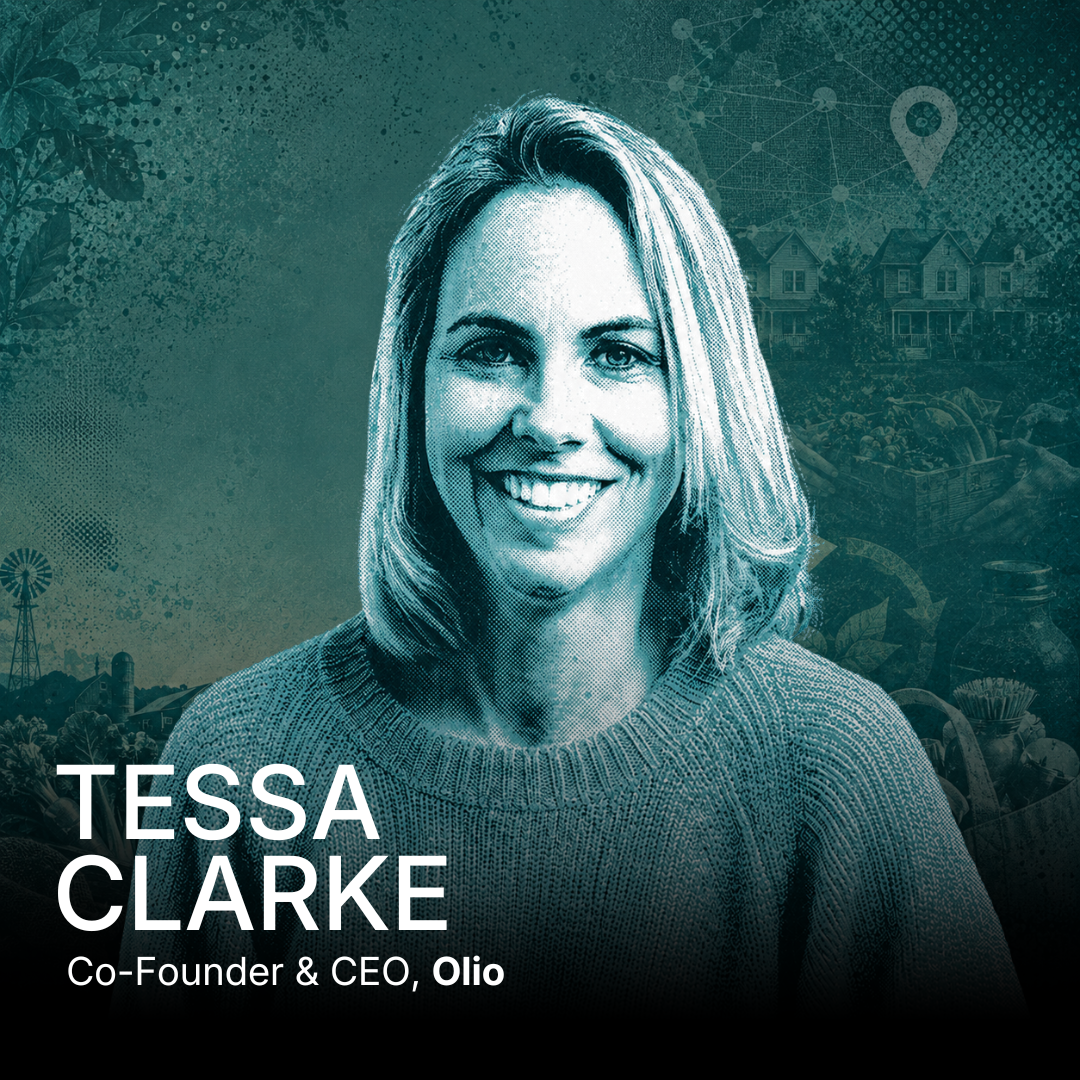
Tessa Clarke
Co-Founder & CEO of OlioTessa Clarke is the co-founder and CEO of Olio, the number one food sharing app on earth, which connects people with their neighbors so spare food and household items get given away rather than thrown away. A farmer's daughter from the northeast of England, she studied Social and Political Sciences at Cambridge, earned her MBA from Stanford, and spent 17 years in corporate digital businesses before co-founding Olio in 2015. Tessa joined the Unreasonable Fellowship in 2018 through the Unreasonable Impact program, run in partnership with Barclays.
Key Takeaways
Olio has grown into the number one food sharing app on earth, with 10 million users, items shared in 63 countries, 150 million meals redistributed, and 16 million household items given a second life instead of going to waste.
Two thirds of Olio's community say they have made brand new friends through the app. A third party framework recently valued the company's lifetime social impact at 1.1 billion pounds, as large as its environmental impact.
The idea arrived on moving day, when removal men told Tessa to throw away all her uneaten food. She hid sweet potatoes in her packing boxes instead, then asked why no app existed for giving food to neighbors.
Tessa and Saasha Celestial-One incorporated Olio on 9 February 2015, both on maternity leave, giving themselves until 31 December to launch an app, get data, and raise funding before corporate jobs reclaimed them.
Raising just over 50 million dollars took five rounds against investors who called them 'you girls with your little project.' Their response: a credentials slide, promotion answers to prevention questions, and refusing to stop.
Olio's 100,000 food safety trained volunteers collect unsold food from businesses like Tesco and Sainsbury's and redistribute it through their own homes within hours. Across 150 million meals, there has not been one food poisoning incident.
Tessa joined the Unreasonable Fellowship in 2018 through the Unreasonable Impact Program, run in partnership with Barclays, arriving in tears after a bruising Series A and finding a community that reenergized her to keep fighting.
Chapters
Full Transcript
Daniel Epstein (0:00)
It's Daniel Epstein. I have the privilege of being your host throughout this podcast. I get the gift of sharing conversations to unearth the untold stories of individuals who are looking to define progress in our time. And in today's conversation, I am notably excited because I get the chance to dig in and go deep with Tessa Clark. Tessa is the co-founder and CEO of an app called Olio. You can learn more at the Olio app. I first got to know Tessa when she joined the Unreasonable Fellowship in 2018. She came to us through our Unreasonable Impact program that we run with Barclays, and we brought her into the fellowship then because we knew she was on to something that could have an outstanding, outsized global impact on the dual challenges of food waste and food insecurity. Today, their app, Olio, is the number one food sharing app on earth. They have over 10 million users. They have redistributed over 156 million meals. And they've gone beyond food. They've gone to household items. Anything that you may, you know, want to throw in the bin or potentially take to Goodwill, you can now post on Olio and your neighbors can come by. You can create community, and, you know, it's a beautiful representation of a belief that our needs make room for other people's gifts. They've now shared over 17 million household items. Tessa and her co-founder started this company while they were on maternity leave, and to date they've raised over $50 million. They are doing something absolutely remarkable, and in so many ways, they're just getting started. So without further ado, it is my privilege to be able to share this conversation and introduce each of you who are tuning in to Tessa and the work that her and her team are leading at Olio. Well, Tessa, I am incredibly grateful, one, to know you, to have been on this journey with you now for, I think almost eight years. But also that you're taking time, to have this conversation, to dig into Olio, to dig into your story and just reconnect. So I want to begin by saying thank you for taking the time.
Tessa Clarke (2:08)
It is my very great pleasure.
Daniel Epstein (2:10)
Okay, Tessa, where are we going to go? I'd love to start for anybody who's tuning into this, with just what Olio is. And then we're going to go into the story, then we're going to go into the future. We'll kind of weave all that together. But can you begin by telling us a little bit about Olio?
Tessa Clarke (2:28)
Yes. My favorite topic. So, in a nutshell, Olio is a circular economy app and we essentially exist to tackle the enormous problem of waste in our homes and local communities. And we do that by connecting people with their neighbors so they can give away, rather than throw away their spare food and household items. How it works is really straightforward. Perhaps if you're in your home and you may be about to go away for the weekend or you've overcatered for a party, you would just snap a photo of your spare food, add it to the app. People living nearby get an alert. They can browse the listings, request what they want and pop around and pick it up. And then people also use Olio to share their household items as well. So perhaps they're decluttering the kids playroom or the toiletries drawer or their closet, whatever it might be. So we're hyperlocal, neighbor to neighbor, and it's about giving items away and giving them a second life rather than sending them off to waste streams. And then we also have a proposition whereby we've got 100,000 food safety trained volunteers who collect unsold and unserved food from businesses and they then take that food home, add it to the app and give that food away to their local community.
Daniel Epstein (3:37)
So you said hyperlocal, which is true. And at the same time, in many ways, you're global. Just the numbers, I believe, you can correct me if I'm wrong, but it's over 9 million users on the app today, is that right?
Tessa Clarke (3:50)
Yep. So we've actually just passed the milestone of 10 million people having joined the Olio community. We've had items successfully shared in 63 countries around the world. And then in terms of our impact, we've had 150 million meals' worth of food safely redistributed, and we've had 16 million household items given away, too.
Daniel Epstein (4:13)
Tessa, that's insane. It's incredible. When you started this, did you think this was possible? Like, one, did you know that this is possible, you're going to get to this level of scale, and in many ways, you're also, you know, just beginning with the potential of where this can really go, or did it start out as, you know, something smaller and it's just organically grown into what it is today?
Tessa Clarke (4:35)
Well, it's a combination of both, to be honest. When Saasha and I first came up with the concept of Olio, I mean, we were horribly naive. We had stumbled across the problem of food waste, realized there was no meaningful solution to it, and we thought if we just create an app that will safely connect people with their neighbors, then they'll have a way to give this away instead of throwing it away. All we need to do is launch an app. Everyone will find out about it. And actually, we had rather hoped that, you know, a decade later, which is where we are now, we would have hundreds of millions of people using Olio, not just a handful of million people.
Daniel Epstein (5:07)
The vision was always big.
Tessa Clarke (5:08)
Yeah, the vision was always really, really big because we realized really early on that if we wanted to commit our lives to doing something entrepreneurial, we knew we'd have to give our heart, soul, and some to it. We put our heads down for five to 10 years, and we only wanted to do that for something that we believed really could have an impact at scale kind of equivalent to the likes of Facebook and people like that. So, on the one hand, you know, we are really proud of what we've achieved, and actually, we're having impact in many ways that we didn't even dream of when we set up Olio, in particular, in terms of the social impact we're having. That wasn't even on our radar screen. But, yeah. But also, we're nowhere near where we want to be.
Daniel Epstein (5:51)
So proud, and you realize how much further this can go in terms of the impact it can have.
Tessa Clarke (5:57)
Proud and frustrated. Yeah.
Daniel Epstein (5:59)
Proud and pissed. No.
Tessa Clarke (6:01)
Yeah, absolutely that.
Daniel Epstein (6:03)
One of the coolest things about the app is that it connects you into your neighbors in ways that you may not have before. And, you know, the world's so isolated today in so many ways. Like how has that shown up for you all? Do you have numbers on it? Do you have stories on it that you can speak to?
Tessa Clarke (6:21)
We do. We have both. And, honestly, it came as a really big shock to Saasha and I because we really thought about this as an efficient marketplace solution to an environmental problem. And what we really, really quickly realized was that people joined Olio because they hated waste. They kept using Olio because they were making friends through the app. They're building really strong local communities. So we know that two-thirds of our community say they've made friends through Olio and—
Daniel Epstein (6:47)
Like new friends.
Tessa Clarke (6:49)
Brand new friends. Yes!
Daniel Epstein (6:50)
That's so cool.
Tessa Clarke (6:51)
Yeah. And as you've alluded to, we are living through a loneliness epidemic which is killing people at scale, right? So people are using Olio to make friends. That's two-thirds thirds of our community say they've done that. Three-quarters of our community say that sharing has improved their mental health, and roughly 85% of our community say that sharing's improved their family's finances. And obviously during a cost of living crisis, that's really, really powerful. And we've got stories coming out the yin yang in terms of the friendships that have been made. But one of these sort of challenges we've encountered along the journey is I could share with people, that sort of, that data that people making friends. I could share wonderful stories, but I could sense that people weren't really taking it that seriously, as serious as they should be. And so we've actually just spent the past year working with a third-party consultant on a third-party framework to apply a financial value to the social impact that we're having.
Daniel Epstein (7:50)
Oh, wow.
Tessa Clarke (7:50)
And even we were stunned by the results because last year Olio had 385 million pounds sterling worth of social impact. And over our lifetime, we've had 1.1 billion pounds sterling worth of social impact. So we're an impact unicorn. Yay! But in terms of, kind of how that's calculated, a large chunk of that comes from these sort of mental health benefits that people are getting as a result of connecting, having access to food, alleviating their family finances. Our volunteers are getting a lot of benefits through having the purpose and satisfaction of volunteering. And then there's also—it's much smaller, but is quite important as well. There are some physical benefits from using Olio. So people are walking and cycling, getting out and about in the local community. So all of those things collectively mean that our social impact is just as big as our environmental impact.
Daniel Epstein (8:46)
And that they're inextricably linked. And it's like a, it's a beautiful example of that. You know, most people who launch an app that has, you know, it's been recognized, I believe by Apple as top new app multiple times. You are oftentimes the globally number one ranked app on sharing. You said 150 million meals have been shared and distributed. I think you said over 15 million household items have been exchanged. Most people would be really, you know, elated with that level of impact. And yet part of you is, and another part of you is frustrated. Do you know where this—where does this drive to really bend the arc of history, where does this come from for you? Do you know?
Tessa Clarke (9:37)
Yeah, I mean it is sort of slightly strange because to be sort of proud versus pissed off. I would put us at 5% proud and 95% pissed off.
Daniel Epstein (9:46)
Tessa, you have to tell me more.
Tessa Clarke (9:49)
No, I'm being deadly serious. So to answer your question, kind of where does that come from? That's kind of a little strange. I guess the honest answer is I don't really know. But I've been driven by a very, very strong sense of destiny, karma, just a need. I feel like I've been sort of called to do this work, which might sound a little strange, but, I think that I can remember very, very clearly going through the process of researching the problem of food waste at the beginning of our journey and being absolutely blown away by it. And I couldn't believe it wasn't on the front page of every single newspaper, you know. Globally, people throw away a third of all the food we produce. 800 million people are going to bed hungry every night. If it were to be a country with the third largest source of greenhouse gas emissions after the USA and China, food waste uses a quarter of humanity's fresh water. Like the list goes on. And yet no one was not only talking about it, but no one was actively working to solve it. And as I— I guess I've naturally got a tendency to think a bit, kind of in a systems thinking type way. And it was just very, very clear to me that solving food waste is one of those sort of, you know, I'm going to use a terrible pun, but it's like a low-hanging fruit when we think of decarbonizing our societies and making sure that really precious resources is used. And I remember talking to a friend from business school about it in the very early days because basically both Saasha and myself were giving up these, you know, relatively speaking, pretty high-powered corporate careers to launch a food sharing app. And I think most people thought that sort of baby brain had got the better of us. We were on maternity leave at the time. And I could remember talking to a friend—
Daniel Epstein (11:26)
You were on maternity leave while you imagined this? That's incredible.
Tessa Clarke (11:29)
Yeah. Baby brain helps you see the world more clearly than when you were stuck in the rat race. I don't know, but this friend, I was kind of, "oh, we're being crazy doing this." And he just said to me, "if you, with all of your knowledge as to how big this problem is and your energy and capabilities is going to turn your back on this, then who is going to solve it?"
Daniel Epstein (11:53)
That's why it's not going to happen.
Tessa Clarke (11:54)
Yeah, really great question. And so from that moment onwards, Saasha and I just have committed ourselves to work really hard to solve this problem. And I think the fact that we are, you know, cut us and we bleed Olio, we are absolutely mission obsessed. That gives us a level of resilience that no matter how many knockbacks we get, we are going to get back up again and get back into that ring and just keep on fighting day in, day out. I think we're over 4,000 days now. We're still standing somehow, and it's the mission that drives us to do that.
Daniel Epstein (12:32)
Well said. We're going to go into some of those setbacks and the challenges. But first, I'd like to go way back to the beginning and just hear a little bit from your own reflections how it is that your childhood or how you were raised informed who you've become today.
Tessa Clarke (12:49)
Yeah, it's a really interesting question because now that I'm a parent and I've definitely hit over the middle of my life, you start becoming quite reflective about these things in a way that I quite frankly didn't in my 20s and 30s. I grew up on a farm in the middle of nowhere in the northeast of the UK. It was very rural, very isolated, very happy. And it was sort of my mum, my dad, myself and my two younger brothers. Myself and my younger brothers, we were the family workforce and—
Daniel Epstein (13:18)
On the farm. Love it.
Tessa Clarke (13:20)
On the farm. Yeah. You know, my parents had no qualms whatsoever with the concept of child labor and honestly, we just had to pitch in and it didn't matter how tired we were or how wet or cold or miserable it was outside, you know, the animals need tending to. We had to get out and do that work. And I'll never forget, it was summer, maybe I was sort of 10 or so, and my parents decided to experiment with organic farming. And that summer, they'd set aside a nine-acre field, which anyone who knows how big an acre is you know, that's massive. When you've got to, as two, three young children, you've got to sort of weed that whole entire feed field by hand. Yeah. And so through that upbringing I learned that food is just incredibly, incredibly precious. And I would never ever dream of throwing it away. And I've always gone to what I now look back on and can see a quite disproportionately crazy lengths to avoid food waste. Although I never really thought anything about it. So my upbringing definitely instilled in me the value of food, the value of hard work, important to resilience.
Daniel Epstein (14:24)
Yeah.
Tessa Clarke (14:25)
And the other thing that's kind of weird that I reflect on is I spent all of my teenage years, my 20s, even into my 30s, not quite hiding my upbringing, but I definitely wasn't proactively volunteering it because honestly it wasn't something that most of the kids or people could relate to or understand. And so I kept it sort of quite quiet and quite hidden. And also, I didn't have any role models in terms of people working in businesses or in corporate careers, which is what I ended up doing. And I thought actually that my farming upbringing wasn't particularly useful setting me up for a business career. But actually now upon reflection, when I look at my entrepreneurial career—
Daniel Epstein (15:05)
That's right.
Tessa Clarke (15:06)
Wow. Growing up on a farm, you know, it might not look like it at first pass, but if you dig beneath it, it's an amazing, sort of starting point for an entrepreneurial journey. Because when you grow up on a farm, well, obviously I've talked about all the hard work and resilience and stuff, but you are having to solve problems every single day, multiple times a day. It's like when you're working with animals, the weather, machinery, none of which are predictable or cooperative when you want them to be, and then you're also working with inadequate resources, and so you're having to problem solve on the fly, think creatively, laterally. I've realized that actually my farming upbringing has been really, really powerful. That sort of melded with my corporate career, I think has really helped Olio on our journey. So we've been able to kind of span both worlds, that kind of scrappy entrepreneurial startup piece and then meld it with a lot of the good stuff that I learned through, I think it was a 17-year corporate career.
Daniel Epstein (16:02)
You had a 17-year corporate career before this?
Tessa Clarke (16:04)
I did, yes.
Daniel Epstein (16:05)
You're incredible, Tessa.
Tessa Clarke (16:07)
For all my sins.
Daniel Epstein (16:11)
I'm curious. You're growing up on a farm with your hands in the dirt, it sounds like all the time. How do you relate to the natural world and to nature?
Tessa Clarke (16:23)
That's a great question. So as soon as I could leave the farm, I did. I hot-footed it off the farm because it was really clear to me that I didn't want to be a farmer. I think because I am a bit of a kind of a dreamer and that systems thinking type piece. And whilst your impact is incredible on a farm, it is by definition kind of super hyperlocal. And I studied social and political sciences at Cambridge University and there I really got introduced to the idea of politics and philosophy and economics and social anthropology and social psychology and philosophy. And I found myself really interested about that intersection of kind of humanity and systems. But the inner farmer's daughter in me has never died. Like I love just kind of getting shit done too. So yeah, I think that has worked pretty well.
Daniel Epstein (17:17)
We talked about studying philosophy. Is there a philosophy that guides you that you kind of hang your hat on the most these days?
Tessa Clarke (17:27)
Do you know what? I wouldn't say so. I think I'm a little bit, I don't know if the right analogy is a magpie, but I just steal great ideas. Wherever I see them, I meld them together and I guess they become my life philosophy because I'm sort of stealing with pride so much great stuff from people who've gone before me, I'm pretty bad at remembering where exactly I collected what nugget of gold. But I do remember sort of, I think it was at university there was the concept of, I'm going to get it completely wrong, but it was about making sure that everybody has a certain minimum level of utility and access to things. And that has always certainly kind of guided my approach. Like I just really think there should be an absolute floor that humanity should take a lot more pride in making sure that no one slips below it. And that's always motivated me a lot. And I'm much more motivated in figuring out how we can fix that than focusing on how we can help, you know, the top 5% be 10% better.
Daniel Epstein (18:33)
That's right, that's right. And as you said, I might, I think I heard this right. You said 600 million people, in essence, go to bed hungry each day. 800 million people. And yet we're throwing away, discarding a third of entirely edible, good food. Yeah, makes perfect sense.
Tessa Clarke (18:50)
It's absolutely bonkers. And often when people hear that 800 million figure, their head sort of goes to certain continents, which generally, isn't the US and generally isn't Western Europe, but it is absolutely, you know, in, I think the US, I think you've got 50 million people roughly living in food poverty. Here in the UK, we've got roughly 10 million people. And that's just deeply, deeply troubling to me because the reality is we have more than enough resources for all of us, so we need to get a lot better at making sure that everyone has access to those. And it's absolutely crazy and criminal that we're throwing away perfectly good food and household items while someone two doors down is struggling to get by. And that's before we've even taken account of the fact we've got another 2 billion people joining the planet. And in order to feed us all by 2050, we need to increase global food production by over 60%. So it's very, very clear. And then we're now really starting to feel the climate impact on our food supply chains. So to me, I'm really hoping that we're going to sort of collectively wake up and realize that food is precious and we need to make sure it's eaten, not wasted. Mhm.
Daniel Epstein (20:03)
Sounds like growing up on a farm caring for food, you've always known that food is precious. You spoke to that. But was there a moment where you realized, "I got to do something about this" at the scale at which the challenge is asking us to show up?
Tessa Clarke (20:19)
Yes, there was a moment, but it's probably helpful to share a little bit of context preceding the moment. So I was, you know, maybe sort of 10 or 12 years into this corporate career, I had a CV that looked amazing on paper. The headhunters loved it. But I had this sort of growing desire to do something more positive and more impactful. And I can remember going to lots of leadership courses. I was very privileged to go to those. And I'd hear all these entrepreneurs and people having impact at scale talking from the stage. And I'd be so inspired by what they were doing and I'd reflect on myself and I'd just be profoundly uninspired by myself. And I kind of reached the point where I was getting sick and tired of being uninspired by myself. And I often ask myself, you know, if I were to drop dead today, how would I feel about the impact that I've had? And I realized that when I was having that corporate career, that whilst I had a CV that looked great on paper, if I dropped it today, I would not be proud of what I had done with my one precious life. So I had that sort of growing dissatisfaction. But unfortunately, I didn't really know what to do with it. And I had a hunch I wanted to do something entrepreneurial. I had a hunch that I wanted to have a positive impact. And I thought that all I was missing was an idea. And so honestly, I wasted far too many years hoping for an idea to kind of descend from the heavens. And news alert, an idea did not descend from the heavens, but instead what happened was I stumbled across this problem of food waste and it was too big to ignore. And that happened 11 years ago. I was living overseas, moving back to the UK, and on moving day, the removal men told me I had to throw away all of our uneaten food. And the inner farmer's daughter in me was honestly horrified. And then flat out just, there is nothing that will make me put perfectly good food in a bin. So, instead what I did was I bundled up my newborn baby and toddler, which for anyone who's got kids will know that's like a 45-minute exercise in and of itself. And I set out onto the streets in the depth of winter, clutching this food, hoping to give it to this lady who was always outside our local supermarket asking for help. And I showed up there and for some reason, she wasn't there that day. And I can remember so vividly I actually sort of cried because I was feeling super stressed and I'd gone to all this effort on a stressful day. And I knew the removal men were not happy with me for doing this. And I ended up going back to my apartment. And when the removal men were in a different room, I hid the non-perishable food. So it's like these sweet potatoes and a big white strip black cabbage. I hid those in the bottom of my packing boxes. Yeah. And I'm feeling so guilty and thinking, "oh my gosh, I'm probably sort of, you know, cross-border smuggling here. This is probably illegal, I shouldn't be doing this." And I, thought at that point in time, given that I'd been working in the digital space for a decade, I knew there's an app for everything. I was like, "why isn't there just an app where I can just photograph this and where it be normal for me to photograph this and then whoever wants it who lives nearby can pop around and pick it up?" So that really was the light bulb moment. And then most people I told about this idea of a neighbor to neighbor food sharing app, thought I had truly lost my sanity. Yep.
Daniel Epstein (23:31)
That people wouldn't trust each other or the safety of the food and everything.
Tessa Clarke (23:35)
Safety of the food. You know, connecting strangers in real life from their homes to share leftover food is how people positioned it. Yeah. You can understand why people were a little skeptical. But luckily, my co-founder, Saasha, her full name is Saasha Celestial-One.
Daniel Epstein (23:53)
Celestial-One.
Tessa Clarke (23:54)
Celestial-One, yeah.
Daniel Epstein (23:56)
Maybe the coolest last name ever.
Tessa Clarke (23:58)
It is definitely, definitely the coolest last name ever. So she was—I met her whilst studying for my MBA at Stanford. She was one of my closest friends. As her last name indicates, she was brought up by a hippie sort of entrepreneurial family in the Midwest of Iowa. They were not very conservative and she funny enough, immediately loved this idea of a food-sharing app which went on to become Olio. And I think that if I hadn't have had her sort of standing beside me and we kind of just took that leap off the cliff edge together, I'm not sure if I would really have had the courage to do it by myself. I think in particular because certainly back then there were no role models of people like me being entrepreneurs. So I definitely suffered from that whole sort of imposter syndrome thing. It took me several years to use sort of the "E" word, whenever people asked me what I do, to actually be able to say with a straight face that I was an entrepreneur. But doing it with Saasha really, really did help with that. And I think it's made us a lot more successful, being sort of partners in crime together on it.
Daniel Epstein (25:11)
You're right when you say most people like yourself, you don't have many role models. In this case, you're mid-career, you are a mom with a newborn and a toddler.
Tessa Clarke (25:22)
Newborn and a toddler, yeah.
Daniel Epstein (25:23)
Yeah. You're going after maybe one of the hardest, because it'd be low-trust, types of challenges, which is secondhand food in that sense, shared by neighbor's, right. And you're not starting this in Silicon Valley, you're going back to the UK. Also the stats, you're going to know it better than I do. But I know globally it's less than 3% of venture funding goes to women-founded teams. So all of these things are, in essence, working against your perception probably of what's possible. But you and Saasha come together, you make it happen. What was it in the space between you two that kind of gave you permission, do you think, to say, "Yeah I get all these headwinds, I don't have any role models, but we're going to do it"?
Tessa Clarke (26:08)
We were both on maternity leave at the time. And so we gave ourselves— We incorporated the company on the 9th of February, 2015 and we said, "We have got until the 31st of December this year to make a go of this," which meant we had to go from an idea to launch an app to get some data, raise some funding, so that we don't have to go back and get a corporate job on the 1st of January 2016.
Daniel Epstein (26:33)
Yep.
Tessa Clarke (26:33)
So we were incredibly motivated not to have to go back and do our corporate jobs. We'd also set ourselves really, really aggressive timelines and that was actually, probably one of the best things we could have done because it meant that we didn't overthink things.
Daniel Epstein (26:46)
That's right.
Tessa Clarke (26:47)
And then the most important thing we did was it sounds like a really big deal, right? "Oh, I'm going to become an entrepreneur." It sounds like this massive leap, but the reality is we decided to give it a go. It took us, you know, 10 minutes to set up a company online at the UK government website and cost us £15. And it's like, "Wow, okay, well, we've done the first step. We've set up a company." "Great. Okay, what comes next?" And what we've learned about the entrepreneurial journey is it isn't about the big moments, it's just about the compounding impact of thousands of thousands, hundreds of thousands of micro moments. And in just taking all those baby steps and just continuing day in, day out, to put one step in front of another. And in our experience, that's what entrepreneurship is all about. And that's what having impact at scale is all about.
Daniel Epstein (27:31)
Well said. Where does the name "Olio" come from?
Tessa Clarke (27:35)
So Olio means a miscellaneous collection of things or a hodgepodge of things. So we were using a thesaurus at the time, and, essentially, that's what you'll see on the app. When you open up the app, there will just be a random medley of both food items and household items. Olio also means—it's the name for a traditional Mediterranean stew. Stew is a dish that you would make to prevent food from going to waste. So we kind of loved that connection. And then just as importantly, we loved the two O's either side of the word because we felt that was really symbolic of the planet, of community, of circularity, of sharing. And then finally we just loved the sound of the word and we just thought it's a beautiful word. And we knew that to make Olio successful at scale, we had to appeal to a mainstream audience. So we wanted a name that could sound slightly aspirational and we knew it had to be something that didn't sound like it was for a bunch of tree-hugging hippies, because that would never break into the mainstream. And then that's one of the great joys of setting up your own business, isn't it? You can choose whatever name you want, you can choose whatever your favorite color is. And we did exactly that.
Daniel Epstein (28:52)
So cool. On this journey to over 10 million users now on the app.
Tessa Clarke (28:57)
Yes.
Daniel Epstein (28:58)
You've obviously had to raise capital and as we talked about the, you know, the odds were really not in your favor. How has the capital raising journey been? One, how much have you raised? And two, can you just share a little bit about the journey you know, over the last decade?
Tessa Clarke (29:14)
So, we have raised just over $50 million, and we've raised it over five rounds. And I am only just sort of recovering from the PTSD.
Daniel Epstein (29:25)
Yes.
Tessa Clarke (29:26)
That comes with such an experience. Our first round was actually the easiest round we raised. That was our seed round. So we'd launched the first version of the app. We had some good early data and I sort of went and asked for some advice from an investor I knew, and did the classic ask for advice, get investment. So that was an amazing experience. Sadly, never been able to replicate it since.
Daniel Epstein (29:51)
Yeah.
Tessa Clarke (29:51)
And there on in it's just been one long hard uphill slog. Precisely as you say, because the odds are very much stacked against you. And if you kind of unpick that and figure out why is it. I've spent a lot of time trying to understand why that is. And at its core, I believe it's because we have investment committees that are predominantly made up of the dominant demographic. And what that means is they generally don't understand the problem that we're trying to solve. So we would talk to all these sort of wealthy VC guys about the problem of food waste in the home and the community. And they just could not understand it because they weren't anywhere near managing the fridge in their own local household. And they also were not sort of naturally, most of them weren't particularly excited by community-based solutions. It didn't seem at all intuitive to them. And so in the early days, what was really interesting is that three-quarters of our cap table were either female investors or people of color.
Daniel Epstein (30:57)
Wow, amazing.
Tessa Clarke (30:58)
Now in the later rounds, that flipped and it's—I find that fascinating because in the early days, investors are really backing the entrepreneurs, right? Because you know they're going to attack a million times and so you've got to kind of back the team, whereas once you get to the later stage, you're much more kind of investing in the business. And so my advice to any diverse founders is one, definitely sort of know the rules of the game, know that the odds are stacked against you, and then two, do what you can to work around that. So for sure, you know, I would always go look on an investor's web page and if what was— The About Us team page, if what was staring back at me was pale, male and stale, I knew my probability of success was very, very low. And then I also recognize that there are a bunch of both conscious and unconscious biases against this as a female co-founded business. And the major biases are the assumption that we're not ambitious and they were not commercial. And we had so many questions, really probing about whether we were sufficiently ambitious and commercial. And lots of people would refer to us as "You girls with your little project". And it was really quite frustrating. So what we did fairly early on was we reoriented our pitch deck and our first slide was about us. And we put all our sort of seals of approval.
Daniel Epstein (32:21)
All your credentials.
Tessa Clarke (32:22)
All our credentials: Boston Consulting Group, McKinsey, J.P. Morgan, Stanford Business School, to really try and demonstrate, "hey, you need to listen to us seriously." And then we made sure that we kind of front loaded on the ambition piece, on the commercials piece. And then we thought very carefully about what we wore, how we presented ourselves and did everything we could to try and prevent those biases coming in. And then perhaps most crucially, I watched an incredible TED talk that I would point any diverse founder towards by Dana Kanze and she did some—she's a university professor and she wanted to unpick why is it that female founders don't get the investment. And what she uncovered is that female founders are asked what she refers to as prevention-based questions through the pitch process. Just all that kind of downside stuff like, "What happens if Google or Facebook come in and try and compete against you?" Whereas the male founders are asked what she referred to as promotion questions. The upside, like, "How fast could you go?" "You know, could you spin out another product line?" "What would you do if I gave you an extra 5 million?"
Daniel Epstein (33:26)
Yeah. That'd be a nice question.
Tessa Clarke (33:29)
They would be lovely questions. I can attest to—we just got prevention question after prevention question, after prevention question after prevention question. What Dana said to do is you answer those prevention questions with a promotion-based response. So that was something that we always tried to do. But, yeah, it's been deeply, deeply, deeply challenging. Actually, I can remember coming to, I think it was my first Unreasonable program back in 2018.
Daniel Epstein (34:01)
2018. In the fall.
Tessa Clarke (34:03)
2018. Yeah. So we just closed, our series A that summer and I literally just pretty much didn't stop crying the first day at any time when we had kind of group exercises because I was just feeling so traumatized by the experience that we'd been through because on the one hand, I knew that the work we were doing was so important, so powerful. It works, it's scalable, we have to deliver on this. And yet on the other hand, just to be constantly butting up against this wall of male cynicism was just exhausting. So it was really, really powerful actually, joining Unreasonable and being part of a group of other entrepreneurs who had lots of similar stories to recount, but could also kind of give me the support and the reenergizing that I needed at that point in the journey to kind of pick myself up again and keep fighting.
Daniel Epstein (34:54)
Well said, Tessa. And I, you know, clearly I can't empathize, but I can imagine. And before we go into the journey between 2018, when we first met, up to today, I also just acknowledge, actually when you came in to the Fellowship, it was so incredibly clear how powerful you are and how potent the solution is.
Tessa Clarke (35:18)
Thank you.
Daniel Epstein (35:18)
And even where you're at then, let alone where you're at now, if we go towards the future to ask you a promotion question that said, I'm curious, ten million users, a hundred fifty million meals shared over 15 million household items and you feel like you're just getting started. What does Olio look like when it realizes the full potential that you know is inherent in the work that you're leading?
Tessa Clarke (35:47)
Well, honestly, I just want to put multiple zeros on all of those data.
Daniel Epstein (35:51)
couple more commas.
Tessa Clarke (35:52)
Yeah, seriously—
Daniel Epstein (35:53)
Just one more comma on all of those.
Tessa Clarke (35:55)
Yeah, but I mean, even so, that 150 million meals, for example, if we sort of laser in on that, that has been primarily generated by our activity just here in the UK. And here in the UK, we can be more than double, triple, quadruple, sort of what we are today. Whilst we've made great progress into the grocery retail sector, we're still really early days unlocking food redistribution for all the other sectors. So QSR, hotels, office canteens, school canteens, hospital canteens, TV and film production shoots. And the big one that we're really focusing on right now is corporate events. So if, you take corporate events for example, there's a million corporate events that take place in the UK alone each year, all by definition overcatered. And almost all of that food is going off to waste streams. So absolutely we can be many, many, many, many factors larger than what we are today. And it's the hyperlocal and almost real-time nature of Olio which is the real USP. Because that means we can redistribute hot food, chilled food, frozen food, food with a use by date today, which means it must be redistributed by midnight. And we have volunteers picking up surplus food from Sainsbury's stores at 10:45pm at night and they are getting that food home and redistributed before midnight. So yeah, it's a lightning quick, highly scalable model because it's kind of technology powered by community. Yeah. And the reality is that whilst the majority of food waste takes place in the home, it's difficult for people in the home to realize that they are the problem when they see so much waste being thrown away by businesses. And businesses don't want to educate customers because they don't feel like teaching them.
Daniel Epstein (37:50)
They want to hide it.
Tessa Clarke (37:51)
And they are, at the moment, the businesses are doing all of their food waste behind closed doors because they have no incentive to let everyone know what's going on. and so I feel like as we're starting to get increasing geopolitical uncertainty, as the impact of climate are starting to really kind of ramp up and impact supply chains. I'm hopeful that that is going to shine more of a light on the need to use the food that we've already got in a country to improve the food security, therefore to increase the national security. And we'll get more and more businesses like properly proactively leaning in to solve this problem and then from there we can then move on and tackle the problem of food waste in our homes.
Daniel Epstein (38:37)
That's right, that's right. Yeah. It feels like you have two very different, I guess, customers in that sense. You have the individual who wants to use the app to eliminate their waste but also get goods at no cost and connect with their neighbors and build community through it. And then you clearly have these large corporations and institutions on the Individual level. If, let's say I really want to bring Olio into my local neighborhood, what have you seen as the number of neighbors or people in the community that you tend to need to have for it to start to really, you know, grow, grow on its own or take on a life of its own?
Tessa Clarke (39:14)
Yeah, well, it's always remarkable to us actually how few people are required to kickstart sharing. I think it's partly because sort of the inner student never dies in any of us. So everybody is always interested in free food or free household items. So the real thing is just getting the first 1, 2, 3, 4, 5, 10 people to add their spare in a local community that then gets the flywheel going because people pop around, they pick it up and reciprocity kicks in. People get inspired by other people's use cases and think, "Oh gosh, yes, I've got toiletries drawer and I could do a decluttering that too." And then sort of off it goes from there. And that's that sort of hyperlocal flywheel is why we've invested quite heavily in our brand ambassador program. So we now have about 50,000, over 50,000 ambassadors, all over the world. And they're people who are passionate about our mission but also quite selfishly want to be able to use the app in their local community. They recognize that unless they get their neighbors on the app, it's not going to work. And so what we do is when you sign up to become an Olio ambassador, which you can do on our website or in the app, we then put you on a digital pathway and give you digital content for you to share into your social network.
Daniel Epstein (40:28)
Very cool.
Tessa Clarke (40:29)
And then also you can either download or we will mail to you posters and letters and flyers. So good old fashioned guerrilla marketing is incredibly powerful. Again, it's one of those channels I think is really overlooked by most startups that just default to digital channels but actually something put through your door, by a neighbor that—we leave a little space where the neighbor can come sign a name as well—is remarkably effective.
Daniel Epstein (40:58)
So cool. I also feel like this would be such a fun thing to do with your kids. Like if you're in a neighborhood— Right? 'Cos instead of going door to door selling cookies, it's like you're bringing the whole neighborhood together to be able to share with each other.
Tessa Clarke (41:10)
I have to say, so obviously, you know I grew up in the fields, my kids grew up flyering and they absolutely love it. It's so fun. They are like racing to see who can get most flyers done. It does make you realize, I don't know if this just a UK problem, but how absurdly unstandardized our letter boxes are and how some of them, like, snap your hands off and they put them in all sorts of different locations. So each house, it's a bit of a sort of test to can you find the letter box? Can you actually get something through it? But yeah, it's remarkably satisfying.
Daniel Epstein (41:43)
So cool. Well, I'll make a commitment. My wife and I, we moved to a new home here in Boulder, and I really want to get to know our neighbors. It's relatively rural, so we're going to go door to door. I think just knock on the door, introduce ourselves. But what a fun thing to be able to do. And I could see how so quickly that would just take up steam and energy as soon as one person posts one thing.
Tessa Clarke (42:04)
Yes, exactly. That kind of gives everyone else permission. It inspires other people and then people have that connection. And just the number of stories that come out of those doorstep connections are just really—
Daniel Epstein (42:17)
Two-thirds of people made new friends.
Tessa Clarke (42:19)
Made new friends. Yeah. Yeah.
Daniel Epstein (42:21)
Two-thirds of 10 million users? That's insane.
Tessa Clarke (42:24)
We often get people who are new to a community or new to a city in particular, they will use Olio a lot as just a really sort of low touch way to kind of get to know people. It's like low pressure. It's, yeah, it just kind of works really well. It gets them exploring the neighborhood, gets them meeting local people and it works.
Daniel Epstein (42:45)
I imagine if I lived in Manhattan or San Francisco or Denver, in any city, if I lived in an apartment building.
Tessa Clarke (42:52)
Yeah.
Daniel Epstein (42:53)
You know, it's so weird because I lived in an apartment building for a couple years. My wife and I, we lived in a loft and it was amazing how few of the people in that building we actually knew. It was sad. Like we're sharing walls, we're sharing ceilings and floors and yet we're isolated and it just seems like that'd be such an easy thing to do. And some of these buildings have, you know, thousands of people, let alone if you have 20 in a small apartment complex, that's got to be, that's got to be fun and relatively frictionless.
Tessa Clarke (43:22)
It is. And also Olio has been designed in such a way just to make that connection really safe and easy and fun. So, you know, every user has a user profile, is user verified. We have a really strict way of, if anyone sort of no-shows, we will warn people, then suspend people from the platform. So we really kind of hate time wasters. So broadly, the Olio community is really polite and friendly and courteous. And yeah, and then we've got some lovely things sort of within the app. So we've got this sort of digital thanks tool where you can send someone a thanks for the thing that you've picked up or thank someone for taking something off your hands. And again, the amounts of photographs that are being shared by people like, "Here's your old cabinet that was taking up your space that was doing your head in. I have now taken it and upcycled it and it's just transformed my living room." Or you know, we've had families sort of, where kids were having to eat meals on the floor and now they've got a table that they can actually eat their dinner on. It's like, wow, you only have to have one or two of those sorts of experiences to make you realize, yeah, just how valuable your stuff is.
Daniel Epstein (44:35)
Yeah, yeah. Instead of tossing it.
Tessa Clarke (44:37)
Yeah.
Daniel Epstein (44:38)
Which is, it's unreal how much, not just food but things get tossed today and how many people would love them. Well, there's two things. One is the system wasn't built until you built it. But two, you know, trust is in large part, I feel like in modern society, it feels like it's been broken in so many ways, even between, between neighbors and there's so much fear associated with strangers. I'm curious, how have you overcome the trust hurdle? Like at Unreasonable, we really believe we, you know this better than I do. We innovate as quickly as we build trust and for us, the most important currency we have is trust. I can't imagine anything in Olio would be possible without it. So I'm curious how you've brought trust into the equation.
Tessa Clarke (45:29)
So that's something that has been front and central from day one. And I do think that because we're a female co-founded business.
Daniel Epstein (45:37)
Agreed.
Tessa Clarke (45:38)
We have and we're connecting people to meet strangers to meet in real life. It's something that we have really kind of over indexed on in terms of making sure that we have baked features and products into the app to make that trust piece work. And honestly, there are countless touch points and ways in which we've done that. But perhaps, and also what has been interesting is at every point in the Olio journey where we've had sort of a trust-based decision to make, we have made the right decision. The decision that optimizes for trust and safety. And every time I've taken those decisions, I've thought about the founders of the other scaled social networks and I've realized that every single time without fail, where I took the trust and safety choice and perhaps, sacrificed pace of growth, they chose exactly the opposite path.
Daniel Epstein (46:28)
Opposite.
Tessa Clarke (46:28)
And I'm very, very unforgiving, of those founders because they know full well what they were doing because I've been in their shoes. But another thing that's been actually even more challenging for us in the trust piece is encouraging people to believe that someone else would want what they don't want. So people are very, very kind of shy or reserved about—
Daniel Epstein (46:56)
They think it's their trash. They're used to throwing it away.
Tessa Clarke (46:58)
Exactly. And so they sort of worry that they might be insulting someone or you know, if they wouldn't walk for five minutes to go pick it up, they assume that no one would walk for five minutes to go pick it up. But again, I think once you've used Olio a couple of times and the people who do have more than enough are really confronted kind of with the reality of the society that they live in. And very quickly you realize, "Oh my goodness, pretty much everything I have is of value to someone else, even stuff that I think is broken, someone else would love to take and repair and reuse and mend." And yeah, I think it's been quite a wake-up experience to a lot of people.
Daniel Epstein (47:45)
And what about on the business side? I can imagine a sports arena or a canteen or kitchen at a corporate office or a bakery or a grocery store that they would all be initially kind of terrified of the downside risk of, well, what happens if one of these parcels of food gets out and somebody gets sick? How do you instill and ensure the trust with them?
Tessa Clarke (48:10)
Yeah, absolutely. So just to recap for people, just to clarify kind of what the model is so they understand.
Daniel Epstein (48:15)
Yes.
Tessa Clarke (48:15)
So we now have 100,000 food safety trained volunteers. These are members of our community. We show them ads and we say, "Help your local business. You stop throwing away food. Rescue their food." We then train them on our online food safety management system. Once they're trained up, they're called a food waste hero. And a food waste hero can then claim a collection slot. And a collection slot is an opportunity to go to your local supermarket or school canteen or office canteen at an allotted time of day. You'll pick up all of their unsold or unserved food, you'll take it home, add it to the app and you give that food away for free to your local community.
Daniel Epstein (48:48)
Oh wow. So they're, they're the hub.
Tessa Clarke (48:50)
They're the hub, yes. And their home is the hub. And so that takes that food from being considered sort of a waste stream at the business location to on average within one to two hours being fully redistributed into multiple homes in the local community via the hub of the volunteers' home. So we've kind of created a hub and spoke model with the volunteers' home being the hub instead of the retail location being the hub.
Daniel Epstein (49:13)
So cool.
Tessa Clarke (49:14)
And you know, before we even launched that model we knew that food safety traceability accountability, was going to be absolutely crucial. So we retained the UK's leading food safety lawyer and we have designed a totally proprietary best-in-class, nothing else like it exists anywhere in the world, food safety management system that is managing and deploying these hundred thousand volunteers at scale, 150 million meals safely redistributed. So, no food poisoning incidents or anything like that happening.
Daniel Epstein (49:46)
Not once in 150 million meals?
Tessa Clarke (49:48)
No. Yeah, we've got proper kind of process that people need to go through to register whether they've had a, food poisoning incident. And yet we haven't had anyone sort of go through that complete process. Our bigger challenge actually is getting people to say "please and thank you" to one another. But from a business perspective, what's really crucial is that the legal liability for the food transfers from that business to Olio when the food is handed over to volunteers, and we can trace because we're a mobile app through our backend systems and our reporting what happens to all of those items of food. So actually our clients love the fact that the liability is very clear. We've got end-to-end traceability. We give them back detailed social and impact reporting. Sorry, social environmental impact reporting. Yeah, it's a kind of highly scalable model. So we redistribute from thousands of supermarkets, about 500 school canteens. But there's another sort of 25,000 we're not redistributing from right?
Daniel Epstein (51:00)
Just in the UK.
Tessa Clarke (51:00)
Just in the UK. We have 25 to 30,000 schools and we're redistributing from 500. TV and film production shoots. Actually, we're doing really well in that sector I think because lots of people move between shoots and when you've worked on a shoot that works with Olio, people are spreading the word. Hey, we really need to work with Olio. So that's working really, really well in that sector. Yeah. But it is sort of the food safety is often the first question that businesses will ask and quite rightly so. When we're redistributing from big, big organizations like Tesco and Sainsbury's and Compass, you know, their teams have been, their health and safety teams, their legal teams have been through everything with a fine-tooth comb.
Daniel Epstein (51:44)
Everything. I can imagine.
Tessa Clarke (51:47)
Yeah.
Daniel Epstein (51:47)
So, to echo that back, repeat that back, the liability, the moment that food gets picked up, it immediately goes to Olio.
Tessa Clarke (51:55)
Transfers to Olio. Yes. Now what if a business put some glass, I'm making this up. But if they put some glass in that food, then you can never dispatch of the liability for the food when it was in your care. So— But anything that happens to the food from the point of transfer onwards is Olio's responsibility and liability.
Daniel Epstein (52:19)
It's not the Food Hero or the Food Waste Hero's liability either. It's Olio's.
Tessa Clarke (52:26)
In the UK, we are a registered food business and we do that on behalf of Food Waste Heroes. Yeah.
Daniel Epstein (52:33)
If I wanted to do this in Boulder, if I wanted to go to the local grocery stores and to the university and to different offices, is that possible here in the US as well? Or is it right now exclusive to the UK?
Tessa Clarke (52:45)
So at the moment we've got Food Waste Heroes program up and running at scale in the UK and also in Ireland. We have got some pilots that have successfully taken place in Singapore and we're hoping to roll out a program there. We have got a couple of retailers in the US that have said they want to pilot with us next year. And we've also got some active conversations underway in Mexico with a large retailer there that wants to pilot with us. Now of course we do need to take this on a country by country basis to make sure that we are meeting all the regulatory requirements of that particular country. But certainly kind of once we are eventually in a country and at scale, we're not yet even at this point in the UK, we absolutely would love to create much more of a self-serve type model where any business can come onto the platform and kind of sign themselves up. Right now, we're really focused on account management sales where we can get hundreds of thousands of locations at once. But eventually, absolutely, you know, we would love every local bakery, corner store, coffee shop in the world to be able to come onto the Olio platform—
Daniel Epstein (53:55)
Cool.
Tessa Clarke (53:55)
And order either in advance or on demand an Olio volunteer to collect their unsold food.
Daniel Epstein (54:01)
That's amazing. So they have no liability. And then they get the data back to their business: this amount of food was saved, this many people were reached, and so they could tell the positive story without any of the downside risk.
Tessa Clarke (54:13)
Yeah. And then we give them— perhaps the most powerful bit of information we give them back are the testimonials, so the real user stories of the impact. You know, so we've had CEOs kind of brought to tears, when they read the actual impact or hear the impact that they are having. And it's also very powerful for them in terms of employee retention and morale because no one likes being paid every single day to throw away perfectly good food, especially not during a cost of living crisis. Especially not if you yourself, or perhaps your immediate community and family are struggling to access food. So it's really powerful from an employee perspective, it's powerful from a customer perspective. So customers do not like to see businesses throwing away perfectly good food. And then there's the environmental and social impact they can have. And then from a commercial perspective, we are competing against the bin. And unfortunately, the bin has a lot of kind of structural advantages that make it perhaps cheaper than it should be. But we have a motto which is that we will never be beaten by the bin. So at the very least, we'll be cost neutral with the bin, or ideally, we try and save money, but every business has a different waste contract structure.
Daniel Epstein (55:25)
Yes, yeah. Amazing, amazing. So no cost increase. Ideally, you're actually saving and all of the benefits that get tied to it. Tessa, this is brilliant. The hundred— You said 100,000 Food Waste Heroes?
Tessa Clarke (55:40)
Yes, yeah.
Daniel Epstein (55:40)
So right now, that's 100,000 people in the UK and in Ireland. Is that right?
Tessa Clarke (55:46)
Yep, yep. Yeah, yeah. So, you know, sort of tonight, as we are speaking, actually, because in the UK, it's coming up to sort of collection time at lots of retail stores. You know, thousands and thousands and thousands of people across the country will be leaving their home, going to their local supermarket, picking up all their unsold food, taking it home and giving it away to their local community and having just incredible, incredible impact for people at scale.
Daniel Epstein (56:11)
So I imagine that this has actually brought in, you said some of these business owners, these CEOs, are brought to tears. I imagine this has brought in so many people to tears to realize that we can do this another way, that we can relate to waste in another way, where it's not what waste, that we can relate to each other in different ways that's much more connected and caring and loving and in gratitude. Has this brought you to tears in moments of, not the struggle, I'm sure it's brought you to tears in the struggle. But in these moments of joy, like have you been able to let it in?
Tessa Clarke (56:44)
Oh, yes. So how we sort of keep going through these 4,000 plus days and nights of waking up and being punched in the face.
Daniel Epstein (56:51)
That's right.
Tessa Clarke (56:53)
Is a couple of things. So we've actually, in the Olio app there's a forum section which is essentially like kind of an old school message board and there's lots of different categories and one those categories there is called Olio Love. You can go into the forum, you can filter for Olio Love at any time of day or night and there will just be a long stream of just beautiful, beautiful, beautiful stories. And also we get emails into our customer support team the whole time with people— all the time with telling us, you know, "If it wasn't for you, my children would not have had food tonight." And we've had people with all sorts of really deep, dark, difficult mental health problems and getting access to food, connecting with their community has enabled them to sort of break out of that trap and get back onto a good path. And actually I remember someone emailed in just a really powerful testimonial last week, I think it was, saying, there was someone who's had a deeply, deeply troubled life, unfortunately. And they said that joining the Olio community was more powerful, more effective than any drug recovery program they'd been on at all. And just the way they had written and described that and just how Olio had completely and utterly transformed and turned around their life was—well, you couldn't help but be moved by that.
Daniel Epstein (58:20)
So you, Tessa, as a leader, co-founding this, you said 11 years ago, more than a decade ago, and having been in this privileged seat of being able to help lead the organization, what have you learned about yourself and how do you embody or think about leadership or what values guide you and has that evolved?
Tessa Clarke (58:44)
So I'd say one of the most important things that Saasha and I did was spend some time in the early days to define our company values. And I remember actually we went through two iterations before we got it right and I think two of them we tried to do it quite sort of team-based but the model that really landed was actually when Saasha and I just locked ourselves away in a room for a couple of hours and we just sort of thrashed it out and we came up with four words. Four really, really simple, powerful words. So they are inclusive, resourceful, caring, and ambitious. And they've been our company values for, I want to say like maybe eight years now. Seven or eight years. And if you sort of cut Saasha or I, we bleed all four of those words. And we recruit everybody to those values. We're just doing 360 feedback right now. Everybody sort of rates themselves against those values. They rate one another against those values. We do our employee satisfaction survey twice a year. We ask everyone to rate how well we think we're living up to those values as a company. Now, we're a remote-first business. It's like we don't have our values written on a wall, we don't have them on a mouse mat, we don't have them on a mug. But they are truly lived and believed. And I honestly just can't think of four better words. They really do just describe how we show up day in, day out. And what I love about them is there's some really nice healthy tension there. So we are incredibly caring, but equally we're incredibly ambitious and they sort of keep one another in check. We're very sort of inclusive, but actually if you take inclusive too far then you stop being resourceful, therefore you can't have your impact. So there's some—they're just a couple of examples of the healthy sort of checks and balances that work between the values. I think the other thing I've definitely learned through this journey is just the power of small actions and then compounding over time. I certainly remember in the early days, we were very naive and idealistic and we thought here's a massive problem, here's an incredible solution. We'll go to bed and we'll wake up one day and we'll have experienced Instagram-style hockey-stick growth. And that hasn't happened. And realizing actually I think for a long time we live sort of in hope—in hope that the next feature, the next hire, the next fundraise, these were things that would result—they were kind of silver bullets that we were constantly searching for and Saasha and I have now given up, searching for silver bullets. And instead, we're just focused on lots and lots and lots of lead bullets and just layering them on, compounding, learning as quickly as we can from our failures and mentally, just sort of breaking up with silver bullets, has been really good for our well-being. So yeah, I think that's some of the key learnings.
Daniel Epstein (1:01:39)
Well said. If I could add a value, I feel like, and you don't have to add it at all, but I feel like it's in there in the word "care". But there's something about love that is very clear in what's happening with, you know, the users of the apps and the app and the space between them as they bring Olio into their lives.
Tessa Clarke (1:01:59)
Absolutely. And I spend, oh my goodness, I spend so much of my time thinking about how we manage the community. Like that's the tricky bit. People instinctively want to talk about food safety, I completely understand that. But actually on a day to day basis, managing a community of scale and all the different sorts of people from all walks of life and making sure that they all feel rewarded, recognized, heard, is really, really, really challenging. And actually underneath sort of caring, the sub bullet points are that we're sort of caring to the planet, to our community, to ourselves. And that community piece is really important. And actually that's one of the things, that's one of the areas where I've learned most is how to manage a community. And some of the major lessons there are the importance of being proactive in communications. So instinctively, most of us have been brought up in corporate environment where we have a tendency to hide stuff, not disclose stuff. And I'm always on it like, right, we need to tell the community, tell the community, tell the community. And then the other mistake I think a lot of businesses make when trying to manage communications with communities is they focus on the what they want to communicate and they completely leave out the why. Like why are you doing this? And there's something profoundly human, we just want to understand the why. And if the why doesn't make sense and if the why isn't truthful, people smell horseshit immediately and it sort of can backfire very quickly. So it really is, it does take a massive amount of my mind share all the features and policies and procedures that we have to manage and maintain that community at scale.
Daniel Epstein (1:03:48)
Yeah, can only imagine. So ambition being one of your values, let's actually talk about the business for a second. One is what is the business model, the economic engine behind Olio? Two, you mentioned casually you've raised more than $50 million. I'm sure in the recent rounds, those investors saying, "Hey Tessa, where's the exit? How do I get multiples back?" I'm just curious about the economic ambition for the organization, where it is now and where you see it moving.
Tessa Clarke (1:04:15)
Yes. So in terms of how we generate revenues really, really important to say that from day one, Saasha and I have always been really focused on the fact that Olio is a profit with purpose business. We have been quite frustrated along the journey. People keep on trying to push us into this false dichotomy, which is either you must be a charity doing lots of good but probably not at scale, or you're a business operating at enormous scale but probably doing all sorts of horrible things for people and planet. We believe very firmly that the new paradigm of business is this third way: profit with purpose. Took us a couple of years to do it. We're now a registered B Corp. We're really proud of that. So for us, having a sustainable business model is just as important as having impact at scale and how we generate revenues, I mean, that's been actually one of the biggest challenges, right, is that there hasn't been a sort of E-com playbook or a SaaS playbook we can just pull off the shelf and implement. Because our operational model is first of a kind, we've also had to figure out how do we monetize that first-of-a-kind operational model. And that just takes a lot of time. So thankfully we've had very, very patient investors who've really been backing us for the long term, for the big size of the prize. And how we generate revenues is we charge businesses for the service we provide. So instead of them paying waste contractors, instead they pay us—
Daniel Epstein (1:05:37)
Less than the bin.
Tessa Clarke (1:05:38)
Yes, exactly. And they pay us, essentially on a kind of per location, per year basis, ranging from a couple of, you know, hundred dollars up to a couple of thousand dollars per location, per year. Obviously, if you're operating with us at scale, you're at the lower end. If you're a law firm with, you know, one fancy canteen, then you'll be paying at the higher end. And then for our larger clients, we sort of convert that into an annual estate fee because we learned that actually, we want people to have a sort of, again using a terrible food analogy, but we want people to have an all you can eat type approach to Olio. We don't want any barriers in the way of them using the service as often as they need it to prevent food from going to waste. So we'll agree that kind of annual, contract up front. So it's a lovely business in that it's sort of high margin recurring revenues. That's about 90% of the revenues and then 10% of the revenues come from a combination of, you can upgrade in the app to become an Olio supporter. And that unlocks a bunch of features, one of which is getting rid of advertising in the app and that's the other.
Daniel Epstein (1:06:41)
Thank you.
Tessa Clarke (1:06:41)
The other part. Thank you. Yeah. I mean it was a very sad day. You know, that was a day where I realized that I had to put my principles to one side and stay focused on the commercials. I never wanted to have to put advertising in the app. I hate the advertising business model. But it was sort of stay principled and die or be pragmatic and stay alive and have impact at scale. So it was, relatively speaking, actually an easy decision to make. So that's about 10% of our revenues and we anticipate that we will be breaking even later on this year or early next year, which is just an incredible milestone. We can't wait to get to that. And yeah, sort of the combination of we've got kind of commercial tractions really picking up. It was quite difficult the last couple of years with this sort of anti-ESG narrative coming across the pond, but actually, commercial pipeline is picking up a lot and in part, that is thanks to some social media vigilantism. So an amazing guy set up an account called the Food Waste Inspector, and he did that at the back end of last year. He's gone from nothing to 100,000 followers and he is just going into the stores, and he is filming and showing all the food in the supermarkets that aren't working with Olio, showing how much food they're wasting and people are understandably absolutely livid. This negative PR is getting quickly escalated to C level which is then accelerating sales cycles quite dramatically. So yeah, that is sort of really good. And then that combined with harnessing the power of AI means that we're feeling—yeah, we're actually in a really good place at the moment.
Daniel Epstein (1:08:27)
When you say harnessing the power of AI is—I was going to ask that earlier. Actually, I won't make assumptions. How are you bringing AI into the business?
Tessa Clarke (1:08:37)
So, I've seen lots of things sort of come and go in my time at Olio. It's like, "Oh, you need to do an ICO. Oh, you need to adopt blockchain. Oh, you need to do whatever it might be." I've lost NFTs. All sorts of things have come and gone, but it was quite clear to me very early on that AI was something completely different and potentially absolutely game-changing. So we've always lent very heavily into it. We had some pretty deep searching questions as an organization in the early days as to whether we should be using AI or not. Right? Because we were well aware of the water and energy footprint of AI and we had lots of questions about is this aligned with our mission to transform the climate crisis? But what we realize is we've done carbon footprinting for our company so we're a remote-first business and our emissions as an organization only offset 5% of the positive impact that we're having in terms of emissions. And so we're kind of 95%—
Daniel Epstein (1:09:39)
20 times carbon negative.
Tessa Clarke (1:09:41)
Yes, correct. That's exactly how it is. And even if AI were to double our footprint as an organization, which it absolutely is not going to, we are still in a wildly sort of net positive space. So we then realize we actually have a duty to adopt AI resourcefully, of course. But actually, we need to really lean into the ambition piece because if AI can enable us to get to profitability faster and can enable us to execute better and faster, which it really can, then we will have more impact more quickly. So, so we have an imperative to harness AI. And the real game changer took place in Q1 of this year. So our productivity per engineering head has doubled in Q1 of this year versus Q4 of last year. And that's because there was a real step change in the models and their ability to work properly across legacy code bases essentially. So we are—now we're going through a bit of an organizational whiplash of suddenly the constraint that we've had for the past decade, which is our precious expensive engineering resource, is no longer the constraint and it's the rest of the organization that's constrained. So we're having to kind of reinvent as we go along all of our ways of working, which is very discombobulating but really, exciting because our ability to ship stuff has just gone through the roof.
Daniel Epstein (1:11:07)
Yeah, it's the coolest.
Tessa Clarke (1:11:08)
It is, yeah.
Daniel Epstein (1:11:10)
So Tessa, we're getting close to time, and I have three more questions. One's relatively fast because we didn't get to it. You're about to hit break even.
Tessa Clarke (1:11:21)
Yes.
Daniel Epstein (1:11:21)
Towards the end of this year, early next year, which is a massive feat as an app-based solution. But as you look forward and in the economic trajectory of the business, like where do you see Olio a decade from now on the ambition, on the economic side of things?
Tessa Clarke (1:11:37)
Yeah, good point. And you asking me that made me realize I didn't answer your question about exits and investors. So, sort of answering the two of them together, so, through our rounds of financing, we have exited some of our early investors and we're incredibly, yeah, we're incredibly proud of the fact that we were able to deliver really excellent returns to them which can then feed back into the ecosystem of impact-driven businesses and that kind of investment thesis. And the investors that we have predominantly now on our cap table are very ambitious but have sort of longer-term time horizons.
Daniel Epstein (1:12:16)
Exactly.
Tessa Clarke (1:12:16)
Which is exactly what we need. And they, you know, we can see how Olio can very, very easily be a you know, 100 million plus revenue business. And as I say, kind of it does just feel like we are only just getting started because to date we've been focused on really predominantly on the grocery retail side of things. But as we look, for example, into corporate events and hospitality, the size of that market is many multiples larger than grocery, retail and we believe that it's going to have much faster sales cycles as well. so we're really excited to do that. So, in terms of product development we're really focused on corporate events right now and then starting to unlock international expansion. And then another thing that we're exploring very tentatively but could also potentially be quite exciting is we have built some really world-class volunteer management technology plus know-how. And we've actually got a pretty large charity that is in the business of watering trees and at the moment they're sort of paying a large number of people to do work when they should actually be working in the office not doing that. And so there is absolutely the potential for us to kind of white label our volunteer management software and know-how. So that's something else that we're again very early days of exploring.
Daniel Epstein (1:13:40)
The World Cup just happened.
Tessa Clarke (1:13:41)
Yeah.
Daniel Epstein (1:13:41)
What about sports arenas?
Tessa Clarke (1:13:43)
Yes. So, we are aiming to pilot with a very large owner of a number of sports and entertainment arenas, kicking off that pilot in September because yeah there's lots of concessions at sports and music arenas. There's then also all the hospitality which of course has to be very abundant which therefore sadly results in lots of surplus food. But what excites me is often it's that sort of, that catered food is very, very high-quality food. And so if you think of the nutritional value of it that is then going to local communities, I think that's, yeah, really exciting.
Daniel Epstein (1:14:19)
Honestly, it's so remarkable what you're doing and as you've shared more and more of the story, there's moments where I can feel it in my body, like my heart is opening around the possibility that you're already making real. There's this sense that like our hearts know a better future is possible and you're creating a path towards that. Something we talk about at Unreasonable often, you've heard us say it, I'm sure, is that our needs make room for other people's gifts, i.e. you know, that circular lens to the picture. But I imagine too, I was just feeling into being one of these Food Waste Heroes. There's something so cool because I may not have excess food in my house, but the fact that I could go to a local business, bring what they would have considered waste into my home, and then give it out to my neighbors, that I can give that gift at no cost.
Tessa Clarke (1:15:10)
Correct.
Daniel Epstein (1:15:10)
Like that's so magical.
Tessa Clarke (1:15:12)
It is. And that's why we have people so often, again, a lot of people will assume, "Oh, will anyone want to, you know, pick up free food?" It's like, "yes." "And will anyone—why would people volunteer?" And trust me, there is no shortage of people who want to volunteer. In fact, they fight over the ability to volunteer because they get to do it kind of on their own terms. So you can either claim an ongoing collection slot which like every Tuesday night at 8:30, you can pause them, you can skip them, or you can collect an ad hoc. "Oh, I'm going to be free this weekend or this night," so I'll see what's available. I can claim it. So I do it. So generally outside of work hours from the convenience of my own home, you get to keep 10% of what you collect, if you would like, as a thank you.
Daniel Epstein (1:15:53)
Very cool.
Tessa Clarke (1:15:54)
And so for some volunteers, that is a really, really important part of the volunteering experience.
Daniel Epstein (1:15:59)
That's their food security.
Tessa Clarke (1:16:00)
Yep. And for others, they're like, "I don't want to eat a single other Pret A Manger sandwich." You know, they don't touch any of it. And then you're essentially like Santa Claus, just like giving out free food in your community during a cost of living crisis. And so you only have to have people telling you, connecting with you in that genuine, heartfelt way, saying, "You know, I have not eaten for two days or three days and you have given me this food." It's like, wow, you know, just the sense of purpose you get. And so we get people telling us the whole time, there's a few phrases that are used over and over again to describe Olio, and one of which is kind of, "You've restored my faith in humanity and you're a beacon of hope." And yeah, I think people, they really relate and we have lots of volunteers saying, "You've really given my life purpose in a way that I haven't had it before." And they really appreciate that.
Daniel Epstein (1:16:55)
So cool. It's like you're—Olio is almost a lighthouse towards this, you know, brighter future, this more connected future, this more circular future.
Tessa Clarke (1:17:04)
Yeah. And I definitely think—I work very closely, alongside James Dyson at Dyson for many, many years. And I can remember hearing him talking about, you know, inventing the first cyclonic vacuum cleaner. And it's one of those things that retrospectively is so obvious. You're like, "How did no one think about that?" We all studied the cyclone effect in physics in year three or four or whatever it was. How did no one else think about that? And I've always felt that sort of ideas that are retrospectively obvious are often the very best ones. And Olio is also something that is retrospectively extremely obvious. But right now we're still kind of pushing a massive boulder up a hill because we exist in a society that right now does not value food properly in the way that it does. We don't care, so quote unquote, about waste. And so we're trying as one small little startup with no marketing budget, to drive behavior change and culture change at scale. And that's really, really hard. But as the climate impact starts to hit, I really do think that the world will sort of wake up and then, you know, we've kind of proven our model, we've got to a good scale, and then hopefully, we can sort of ride that wave as and when it comes.
Daniel Epstein (1:18:24)
Yeah.
Tessa Clarke (1:18:25)
And really kind of our vision is—you kind of want to build the hyperlocal rails of redistribution, right? So at the moment there's billions of us, we're all stuck in our small little boxes stacked on top of each other, not connected to each other. And we want to be that unifying sort of force. And we really want almost to become like a utility. And so each community can use Olio for the things that make sense for them in the way that makes sense for them. So, yeah, we've got a lot of work to do to fulfill on that full vision. Keep me out of mischief for many years to come.
Daniel Epstein (1:19:00)
I would say the greatest compliment you can give to an entrepreneur is their idea is obvious. That's all. That's always only in hindsight. I think that that's very clear here, but it's also extremely apparent how hard it has been to build the rails to make this a no-brainer, to make it obvious, to build the trust to take out the liability, to make the economics a no-brainer. Like I mean, this is—to do it at scale. You're thinking about the entirety of the world. It's clear how difficult it's been, I imagine, to build this.
Tessa Clarke (1:19:34)
It has been brutally difficult. And I do smile though because, you know, for the first five years I did all the customer satisfaction myself. So every evening, every weekend, I was the one responding to all of our emails, which is again, in terms of my leadership style, that's why I've put the customer satisfaction function at the heart of our business. In most businesses, they are, you know, putting a wheel or you know, metaphysical, if that's the right word, basement.
Daniel Epstein (1:20:01)
Figurative.
Tessa Clarke (1:20:02)
Figurative basement. Yeah. Whereas, in our organization, they're kind of right at the front and center because I've experienced live the importance of that function. But as a result of doing that role, we must have had an email, you know, at least once a month, if not sometimes a couple of months of people emailing me saying, "I've had the same idea as Olio." And I remember the first few times I read those emails and I'd be like, "Oh no, we've got some competition coming." And I'd be terrified.
Daniel Epstein (1:20:26)
You have no competition.
Tessa Clarke (1:20:27)
I then realized that actually, there's a very, very big difference between having an idea and actually giving up your life and making it happen and refusing to stop when things don't go your way.
Daniel Epstein (1:20:41)
You started our conversation with saying you almost felt like you were meant to do this. I don't think anybody could just give up their life and apply their brilliance to this challenge and succeed. There seems, at least to me, to be something deeper at work here, too.
Tessa Clarke (1:20:58)
Yes, you're correct. And actually giving up your life is the wrong terminology. Dedicate, dedicate your life is more accurate because, you know, I'm a no regrets kind person. Whenever someone asks me, "Do you have any regrets?" I'm like, "Genuinely, I have none because I try and take the best decisions that I can in that moment in time with the information I've got and I can't expect any more of myself." But when I'm forced to come up with a regret, it is actually that I did not start doing work with purpose earlier on in my career. And so you mentioned that I've had the privilege of leading Olio and that is absolutely how I See it, it's like, wow, how lucky did I get to be paid to get up every single day to do work that's having such incredible impact with such awesome people? And I wish that for everybody else, right? I mean, I think too many people are stuck in what's referred to as bullshit jobs, right?
Daniel Epstein (1:21:54)
Yes.
Tessa Clarke (1:21:54)
And increasingly, yeah, I was there. Got the T-shirt, got the cap, got the mouse mat, got the mug. I feel for people who I think are increasingly recognizing that they are part of the problem. And I would just encourage everybody to be a little bit brave and figure out how you can start showing up as part of the solution. And that might involve you sort of quitting your job and starting a business, or it might involve you just being a little bit braver within your own organization and asking the questions that most other people are probably thinking, which is, "How can we be more sustainable? How can we be more circular? How can we pollute less? How can we waste less?" And you really can't beat the sense of profound fulfillment that you feel through knowing that you're doing—having such a positive impact.
Daniel Epstein (1:22:42)
What is really beautiful about the work of Olio and the rails that you have built is you've actually made it really easy for people to be a little bit more brave. You've made it so simple. You've greased the skids that allow this kind of dormant or latent goodwill that's actually in everyone to come to the surface.
Tessa Clarke (1:23:05)
Yeah, that's a really important point you make. So, as part of this journey and stuff that I've learned is, so a lot of people say, "God, isn't it weird, like strangers sharing food? But if you think about it, what is weird is that for the past 50 years, we've been throwing away our life source. Without food, we die. So what is weird? And it's only this weird modern blip that we've been doing this. For the rest of humanity's evolution, actually, if you speak to the social anthropologists, how we've been so, quote, unquote, successful as a species is precisely because we have shared our most precious resource. And as a result of that, we're actually hardwired to feel great when we share something with a member of our community. But there are lots of barriers preventing people from doing that. And so as part of my role kind of heading up all things product for Olio, I've had to kind of do a mini PhD in behavioral psychology. And actually, how can I learn all those tips and tricks and hacks that have been used for not good intent by the major technology players? But how can I harness those same learnings but apply them to a positive impact through Olio? And so absolutely multiple touchpoints in the user experience, we're trying to leverage those just to nudge people in the right direction and make it super easy and convenient for them.
Daniel Epstein (1:24:29)
Make it easy.
Tessa Clarke (1:24:30)
Yeah.
Daniel Epstein (1:24:32)
Okay, two last questions, I promise: which is you mentioned that you first joined Unreasonable Fellowship through Unreasonable Impact that we ran with Barclays in 2018. So it's been a while. It's been almost a decade. It's been eight years. I am really curious and I don't want this to be bullshit. I want it to be like totally sincere. Our hope with the Fellowship is to give you the same sense of community and belonging that it feels like you're giving the millions of users that engage with Olio.
Tessa Clarke (1:25:04)
It's been the end of a long day. I'm going to try not to get emotional and teary about this. Genuinely, it has been incredibly powerful and important for us because we are just out there on the trenches day in, day out, pushing an effing massive boulder up a hill. And that just gets exhausting. And your energy reserves naturally deplete, and sometimes it just feels like you're speaking Japanese to everybody in a world where everyone is speaking English and no one understands you and everyone thinks you're weird and everyone thinks, they kind of want to metaphorically pat you on your head and ask you to run your little idealistic way. And that sort of response at a time when I have access, you know, to lots of the data and information and can now also see just out in my own day to day life what a tricky situation we're in with regards to the climate crisis, resource depletion, biodiversity, etc. That's just really, really difficult on a personal and emotional level. And actually I went to an Unreasonable well-being retreat at the end of last year and you know, gosh, did I need that. Like the battery was kind of down at 1% and I hadn't realized how much I'd been neglecting the need to kind of top that up. And that Unreasonable community of just realizing, "Wow, actually, hang on a minute, I'm part of all these like-minded souls who are also out there fighting the good fight," really energized me, gave me lots of inspiration, lots of hope. It's all the stories that we're not hearing about, right? And I went to Unreasonable Alchemy maybe 2 months ago it was. And I was just like, "Why are not all these amazing solutions being plastered everywhere?" Because they are—
Daniel Epstein (1:26:49)
Why aren't they the norm?
Tessa Clarke (1:26:50)
Why aren't they the norm? And why don't people know about them? But also you can share so many learnings and best practices. And then what I particularly love and what I think is totally unique about Unreasonable, and I've been on lots of programs in my time, is how action-oriented it is. So different formats, but essentially all boils down to the same thing: I'm a founder. I've got a problem that needs solving, an opportunity that needs unlocking, and we're going to hive mind the wisdom and experience and know-how, plus the black books of all the people in the room and everyone makes specific commitments to me and they make actual introductions to me that accelerate my sales cycle by six to 12 months. You know, I mean, that is just invaluable. And I'm still very much kind of following up on all those incredible commitments that I got from Unreasonable Alchemy and having lots of meetings that are going to help Olio grow and scale. So I think it's the best program ever. And you didn't pay me to say this.
Daniel Epstein (1:27:55)
I didn't, I swear. But let's do it now, because the way any of these conversations that I'm having for this Unreasonable People podcast, when it's our fellows who are all working like yourself, to help define progress at our time, I know time is your most valuable asset. You've given up a lot for this conversation. So I'd love to conclude with, anybody who's tuning into this, myself included, who has this overwhelming sense of like, "Oh my God, Tessa, I want to become a part of the world that you're building. I want to join you, become a part of this solution." How can the world engage with Olio to help you realize the potential? You're going to realize it no matter what. But how can the world help you do it faster?
Tessa Clarke (1:28:39)
So I think the highest impact way that anyone can help Olio is if you work for a company that is wasting food, then working with us or reaching out to us and seeing how we can help redistribute that food. What we really specialize in is that sort of hyperlocal, smaller quantities of surplus food. So we're not talking sort of pallet loads of food higher up the supply chain. We're talking that surplus that is taking place at a local community level. So and in not just sort of obviously in the UK and Ireland and Singapore and Mexico, but in terms of—but actually in any country around the world. Because what we've learned in terms of international expansion is we've spent so much time doing the desk research and selecting the ideal territories. But the reality is that what works for us is we need the right company with the right person in it that's serious about solving this and then we're off to the races. So I think reaching out to us from a work capacity and then secondarily, for people in their homes, like download the Olio app, become an ambassador if there aren't many people using the app near you, declutter your home. Try adding something. That's what I always say to most people. And also if there's not much stuff on the app near you when you open it right now, please don't think that that means there aren't many people on Olio near you at all. The typical food listing is on and off the app within less than 30 minutes. A typical household item is on and off the app within kind of four to eight hours. So yeah, we just really encourage people to take 10 seconds and to share their spare food and household items rather than waste them.
Daniel Epstein (1:30:19)
So fun. So, a user of Olio that has the app, they can be right now anywhere on earth. They can download it, go find their neighbors and start—
Tessa Clarke (1:30:28)
They can download it, snap a photo of any spare stuff that they've got and start sharing. As I said, we've had items successfully shared in 63 countries around the world, so far.
Daniel Epstein (1:30:39)
Yeah, yeah, amazing, Tessa. Maybe as we conclude, I just want to share a belief we have, but I feel like you're the epitome of it is that yes, you know, we can make money and not have a positive impact on the world. That's in large part why we find ourselves in the mess that it seems we are in. Of course, we can generate incredible impact without turning any profit. That's the noble work of the non-profit world. But our belief at Unreasonable, and you are embodying and representing it perfectly, is that if you actually want to maximize either of those long-term profits or long-term positive societal ecological impact, the key is to focus on the intersection of both at the same time. And it's very clear to me that you are not just sitting on top of something that is a unicorn in terms of the impact it's having on the world, which you've already quantified, but it is so clear that you have built what will become a financial unicorn as well. And to have the chance to witness you and what you're building over the last eight years has been a privilege. If we can play even a tiny part on that journey to accelerate, you know, the reality that you're pulling into the present, what a gift.
Tessa Clarke (1:31:59)
It's absolutely our ambition, too. It's obvious that what we're doing is having positive social, environmental impact. Once we've hit that break even point, now we really want to turbocharge things and demonstrate that we can build a really exciting, financially impactful business as well.
Daniel Epstein (1:32:20)
Yeah. Yeah. Because you do that and what will happen and you will do that is you set a new normal, not just for circularity in waste and houses and businesses, but a new normal of what an ambition of a company can actually be and the impact that it can have, yes, for the positive ways that we keep talking about, but also financially. That helps change the game. So thank you for changing the game, Tessa. I'm going to not just download the app, I already have the app, but I'm going to actually bring it into our new neighborhood. That's my promise. We'll go door to door. Just want to say thank you again for all you do, all you've done, all you will do. And more importantly, Tessa, for you just being who you are. It's been a real gift to dig into your story a little bit more today.
Tessa Clarke (1:33:05)
I send all of that right back at you and all of the Unreasonable team. We are hugely, hugely grateful for everything that you guys have done for us and will continue to do for us.
Daniel Epstein (1:33:16)
Just the beginning. Let's enter chapter two. It's a long book we're writing together. Thank you so much, Tessa.
Tessa Clarke (1:33:24)
Thank you.
Never Miss an Episode
Subscribe to Unreasonable Stories and join thousands of listeners learning from the world's most impactful entrepreneurs.